Category0

The Bears Were Wrong: Earnings Season’s Triumphant Return

As seasonality is set to exit its most bearish month of the year, we see September as a win. The market has pulled back, which should not be unexpected with how many days the index moved higher. Fortunately, Chairman Powell’s comments did not totally shock the market, except when he gave investment advice about the value of stocks. Can his tenure end fast enough? The HCM-BuyLine® is positive, and we think any pullback should be seen as a buying opportunity until the trend changes. We are bullish going into the last quarter of the year, and we think 6700 or higher is within reason.
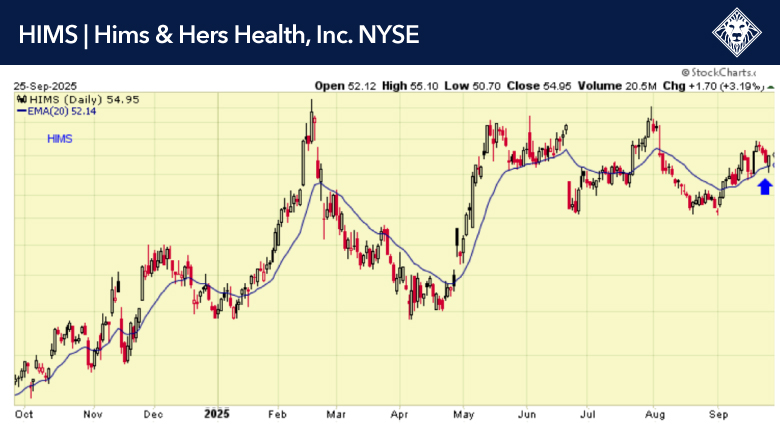
9-25-25-HIMS Chart

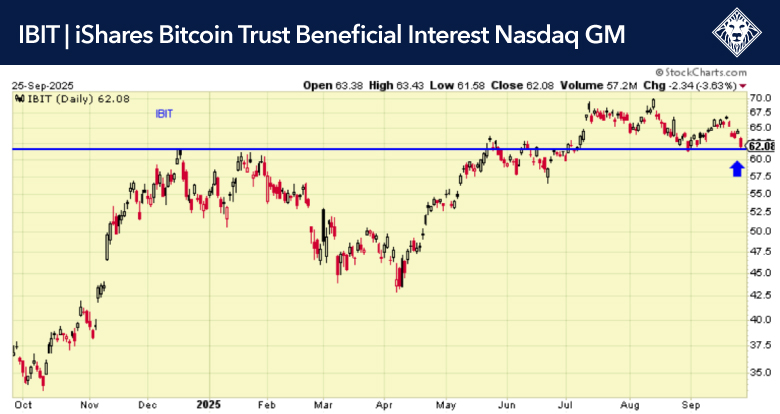
Hims & Hers Health (HIMS) has pulled back and looks to be buyable, along with TD Synnex Corp (SNX), which is breaking out and looks to be gaining momentum. Bitcoin has also pulled back, and we think investors should be looking to buy or add to their position. iShares has a nice Bitcoin ETF (IBIT). If you do not want to buy the coins themselves, the IBIT ETF is highly liquid, and we think it has a lot of bang for its buck.

9-25-25-SNX Chart
9-25-25-IBIT Chart

Stocks have so far not followed the historically weak seasonal trends often seen in September. Instead, the S&P 500 has risen almost 3% month-to-date, with renewed leadership from the growth sectors.

Earnings season has also been strong enough to ease some tariff concerns. Analysts, which slashed estimates following the Liberation Day tariff announcements, were proven to be too bearish. With 98% of companies reporting, the S&P 500’s beat rate has jumped to 81%. Assuming the result is maintained, it will mark the index’s best reading since Q1 2024. Analysts responded by turning more positive and raising 3rd and 4th quarter estimates.

Don’t Fear the Dip: Our Case for Buying Any Pullback

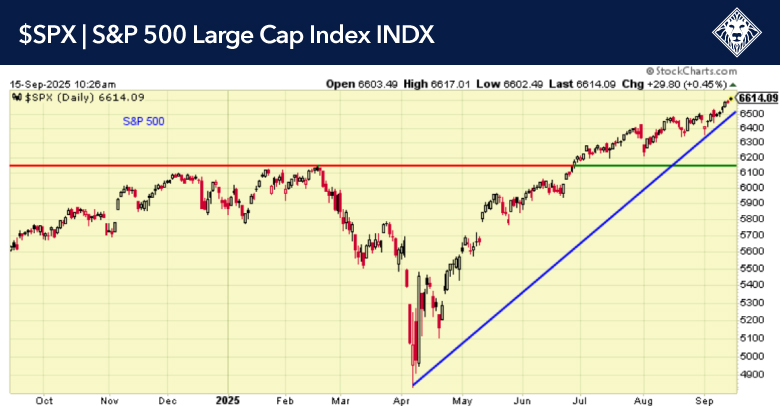
9-15-25-SPX

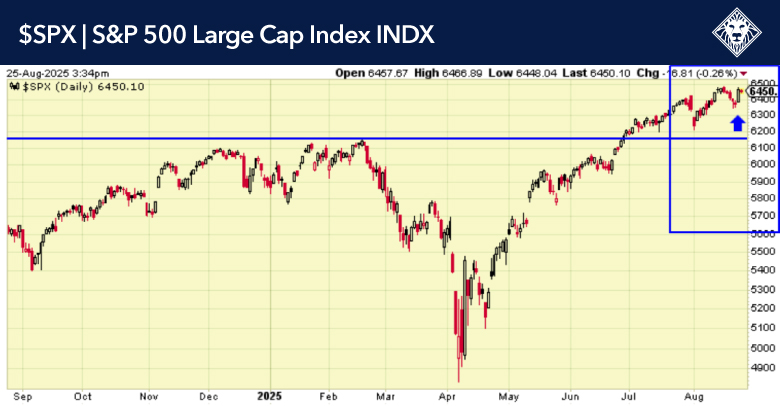
Historically, September and October have not been very good months for the market, but so far in September it is holding up very well. We might expect some volatility over the next 6 weeks, but any pullback should be seen as buyable. I think the last quarter of 2025 could be very strong for the S&P 500, which has already passed 6500, and should reach our prediction of going over 6700 and possibly as high as 7000 by year-end. The markets could have an incredible 5–10-year run. If you’re not heavily invested, we think you should start buying ASAP.

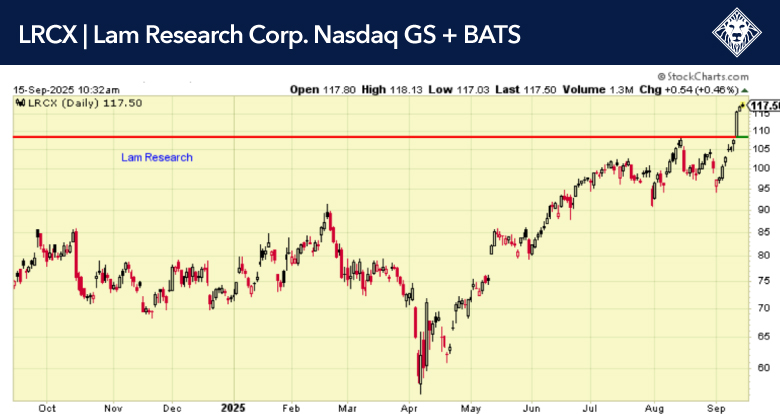
AMD and Lam Research look ready to move higher.

9-15-25-LRCX

An underwhelming employment report secures a September Fed rate cut. Non-farm payrolls increased by 22,000 in August, below expectations of 75,000 and our forecast of 66,000. There was a modest downward revision of 21,000 to the prior two months, in line with our expectations. June now shows a loss of 13,000 jobs, instead of an initial print of 147,000, the first monthly job loss since December 2020. Additionally, the average workweek was unchanged from a downwardly revised 34.2 hours. Average hourly earnings rose 0.3%, matching expectations, but the y/y change eased to 3.7%, below expectations of 3.8%. The unemployment rate ticked up to 4.3%, matching the consensus and our expectation.

This all but secures a 25 bp rate cut at the September FOMC meeting and makes a series of cuts more likely. We have long since argued that a 4.3% unemployment rate would trigger Fed action. We now have that. We have also argued for three rate cuts for most of this year. One 25 bp reduction at each of the next three Fed meetings would fulfill that expectation.

In the establishment survey, private payrolls increased by 38,000 and have averaged just 29,000 in the past three months, the fewest in this expansion. It compares very unfavorably to triple-digit monthly job growth earlier this year, highlighting the dramatic slowdown in job creation amid DOGE, tariffs, deportations, and other policy changes. The trend is consistent with slower overall economic growth, although not a recession at this time.


Is the Fed Listening? Powell’s Dovish Shift Says “Yes!”

The markets are in a solid uptrend, and pullbacks should be considered buyable. Some of the skittishness we saw in markets last week could arguably be attributed to anticipation of Powell’s remarks at the end of the week. But, after a few days of mostly selling, Fed Chair Powell came out a little dovish.

Powell said shifting risks may warrant adjusting the Central Bank’s policy stance. Many investors liked that the Chair is paying greater attention to the labor market, which is much needed because of the recent downward revisions to the jobs report. 

“Overall, while the labor market appears to be in balance, it is a curious kind of balance that results from a marked slowing in both supply of and demand for workers,” he said. “This unusual situation suggests that downside risks to employment are rising. If those risks materialize, they can do so quickly in the form of sharply higher layoffs and rising unemployment.”

New home sales dipped 0.6% in July to a better-than-expected 652,000 unit annual rate, as the prior month was revised up. Even so, new home sales have remained stuck in a range since mid-2022, as high mortgage rates and affordability constraints continue to weigh on demand. A potential Fed rate cut in September could be a catalyst for home sales growth, if indeed it leads to lower bond yields and mortgage rates.

8-25-25-SPX

The S&P Global flash U.S. composite PMI unexpectedly increased (from an already-high reading) in August to 55.4, its best level this year.

The upside surprise came mostly from the manufacturing sector, which unexpectedly bounced back into expansion mode, jumping to 53.3, a 39-month high. Almost all components and individual indexes jumped, including large gains in new orders (including export orders), output, and employment. Finished goods inventories grew at the fastest pace on record, as businesses expressed worry about future supply conditions amid government policy and tariff risks.

The services sector also grew robustly, albeit slightly less so, as the PM edged down to 55.4. New business (including exports) rose to the highest this year, while employment climbed to a seven-month high.


The Job Market is Cooling. The Fed Needs to Drop Rates. It’s That Simple.

8-4-25-SPX

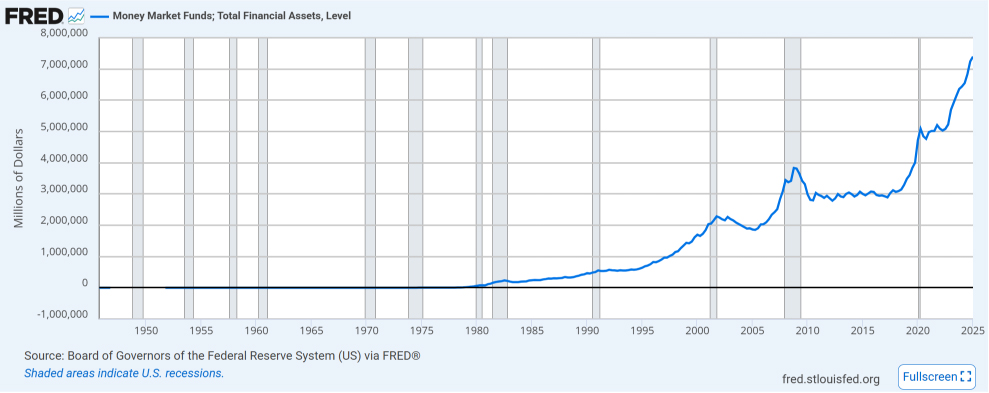
The analysts and economists who are out crying wolf that the sky is going to fall are just about always wrong. Will we have pullbacks and volatility? Of course, markets like to correct and then move higher. But there is $7.4 trillion in money market accounts waiting for any drop in rates, and we should see some of that money moving into equities. The HCM-BuyLine® is positive, and pullbacks should be seen as buying opportunities.

Just as we wrote about last week, the markets like to take what I call “a little Spanish Pause” every now and then. Periods of consolidation are normal and healthy for stocks to move higher.

US equities finished higher in a fairly quiet Monday trading session, with the S&P largely erasing Friday’s selloff (but remaining less than 1% below record highs). Big tech was mostly higher, with NVDA and META among the notable gainers; but market breadth was solidly positive, and the equal-weight S&P only slightly lagged the cap-weighted index.

The Fed is late. They should have dropped rates at the last meeting, and two board members dissented, which is very uncommon. A September rate cut is highly probable in our opinion.

us-nonfarm-employment

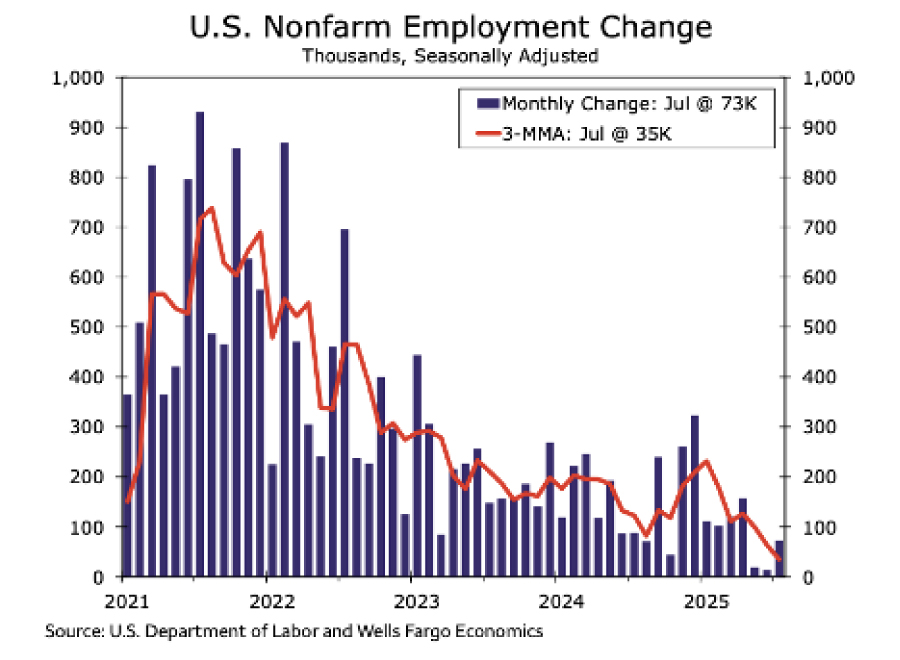
On Friday, we learned that U.S. employers created just 73,000 jobs in July. After May and June’s numbers were revised lower, we learned the three-month moving average was a paltry 35,000. That means the labor market, comprising 159.5 million jobs, is growing by just 0.02% per month.

“Friday’s jobs report, with its below-consensus July reading and very large May and June revisions, reflects a US economy closer to a tipping point than markets or the Fed previously thought,” Nicholas Colas, co-founder of DataTrek Research, wrote on Monday. “Monthly job growth that hovers around zero for a few months in a row is a classic early recession indicator.” Job creation is arguably the most important indicator of economic growth. And it’s not the only metric that’s cooling.

8-4-25-FRED

One of the bigger drags to growth has been personal consumption expenditures, which account for 69% of GDP. Real personal consumption peaked in April, and growth has mostly been flat this year. Come on Fed chair Powell, read the data, it is time to drop rates.


Resting, Not Retreating – Is the Next Leg Up in Sight?

7-31-25-SPX

The market has started off the last three trading days moving higher only to give up the gains. This is a common consolidation process, and we could see a modest pullback. If we do get a pullback, it should be considered buyable. Markets like to take what I call a “Spanish pause” and trade sideways-to-down a bit until it builds up enough steam to break out.

The Fed held rates steady, which was expected, with two fed members voting to drop rates. This is very uncommon. We have started to see a lot of pushback on holding rates steady and not dropping them. We think the Fed has to walk back its inflation views modestly, while the labor market conviction on strength has diminished.

Real GDP rebounded at a solid 3.0% annualized rate in Q2, the most in nearly a year and above the consensus estimate of 2.5%. It followed a 0.5% annualized decline in Q1, as growth in both quarters was distorted by tariffs. Looking through the noise, real GDP growth averaged a 1.25% annualized rate in 2025, which is about half the growth rate in 2024. 

ADP private payrolls rose a bigger-than-expected 104,000 in July, rebounding from the prior month’s 23,000 decline. The increase comes amid reduced uncertainty over tariffs and other government policies, keeping labor demand in positive territory. Average payrolls growth so far this year, however, has been 84,000 per month, down from an average of 144,000 per month last year. The trend is consistent with slower economic growth this year, but no recession.


Markets Soaring, Tariffs Flowing – Don’t Let Fear Keep You Out!

7-24-25-SPX

The S&P 500 is hitting an all-time high, which is one of the most bullish events for the stock market. I have been reading and hearing a lot about how some people are saying new highs are a bad thing, to be careful, and that new highs are unsustainable. This is crazy! New highs are what every investor should want. If the S&P 500 is going to double in value, it must make new highs the whole way up. The S&P 500 is currently at 6350, and for it to hit 12700, which it will someday, it will have to hit new highs the whole way up, so I say “Hip, Hip Hooray for new highs.”

We’re in the early stages of 2Q earnings season. So far, 12% of companies have reported, with 86% beating expectations by an average surprise of 7.8%, suggesting a potentially double-digit EPS growth quarter.

The Treasury just posted a number that turned heads. In June 2025, the federal government collected $26.6 billion in tariff revenue. That’s up from $22.2 billion in May and more than quadruple the $6.3 billion recorded in June 2024. The spike helped deliver a $27 billion budget surplus for the month, the first surplus since 2017. The fiscal year-to-date deficit still sits at $1.34 trillion, but the June print shows what happens when trade policy turns into a revenue engine. There were three new trade deals this week, as agreements were made with Japan, Indonesia, and the Philippines.

Existing home sales declined 2.7% in June, down in three of the past four months, to a below-consensus 3.93 million unit annual rate, the lowest level in nine months. Although still within their three-year range, sales are lower than during the pandemic shutdown and are tracking near the lowest level since 2010.

The latest decline was led by a 3.0% drop in single-family sales, while condo/co-ops were flat. Three of the four regions posted declines, with only sales in the West region up slightly. The crux of the problem remains weak affordability, amid continued elevated mortgage rates and high home prices. For the love of Pete, drop rates.

Home prices are being supported by tight housing inventory, as homeowners who’ve locked in lower mortgage rates prior to the rate spike in 2022 don’t see a financial incentive to sell in the current market. New housing construction is also weak. 


They Called Me Crazy – Now Look at the S&P 500

7-9-25-QQQ

They called me crazy at the beginning of the year when I said my target for the S&P 500 was 6500. In April with the massive pullback, on Charles Payne’s show I reiterated my position, and he looked at me like I had two heads. I had an interview a week back and was asked what my long-term view of the S&P 500 is, and said I think and feel we could double the index in 3-5 years. They just about fell out of their chairs. The media is trying to scare everyone out by saying the markets are hitting all-time highs, should you sell? That makes no sense to me. One of the most bullish indicators, signals, whatever you want to call it, is a new high on the index.

The chart above is the QQQ ETF, which is tech-heavy and has formed a bullish cup and handle.

Feeling a little anxious about the market, even with a strong economy? The truth is, money isn’t fleeing the market; it’s simply moving around, creating fresh opportunities.


Beyond “Uncertainty”: Our Plan for a Predictable Uptrend

6-23-25-USO

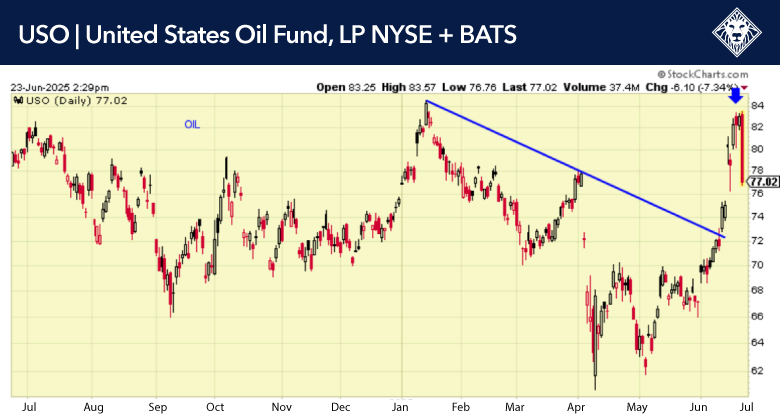
Last week we predicted that the unrest in Iran causing any selloff would be short-lived and any pullback would be buyable, and that seems to be playing out just like we expected. The market is in a solid uptrend, and all pullbacks should be considered buyable until the trend changes. Reduce exposure to oil, as it is now overbought with the turmoil in Iran and should revert back to $60 a barrel if/or after the tension subsides.

6-23-25-SPX

One word that has been overused is “uncertainty”.  Federal Reserve Chairman Powell has worn that word out. Every time he gets in front of the podium, the key takeaway is that everything is “uncertain”. Well, here is some enlightening news, everything is uncertain. The stock market is uncertain, the economy is uncertain, and when we die is uncertain. If he is truly data dependent, then he should start to drop rates.

But the Fed will be late. We don’t expect the Fed to make any policy changes before Powell’s Jackson Hole speech, presumably on August 22, and the conclusion of the Fed’s longer-run policy review. That puts September as a potential opportunity for a rate cut. The Fed will also need to see additional signs of labor market weakness before cutting rates. That means that the FOMC will be late in reacting to the data. We continue to have a fed funds terminal range of 3.50% to 3.75%.

U.S. economic indicators are slowing down. The Conference Board’s Leading Economic Index (LEI) edged down 0.1% in May, in line with expectations, following a downwardly revised -1.4% in the previous month. The rebound in stock prices from the low in April was the biggest positive contributor to the LEI last month. But that was overwhelmed by relatively large negative contributions from consumer confidence and manufacturing new orders.

The LEI peaked in December 2021 and is now at its lowest level in over a decade. The six-month annualized rate of change worsened to -5.3%, the steepest decline since early 2024. Although this is historically consistent with falling economic activity, the Conference Board does not expect a recession this year.


Sectors Splinter, Oil Soars – A Breakdown of What Just Happened

6-16-25-SPX

The trend is up, and pullbacks should be considered buyable. Investors will most likely remain cautious while paying attention to trade developments, particularly between the U.S. and China. The trade talks with China continue to progress and it seems to be, on the margin, positive.

The S&P 500 experienced mixed sector performance last week. The energy sector led gains amid Middle East tensions, followed by healthcare, as oil prices jumped 13.9% to $73.56. Technology posted modest gains following positive U.S.-China trade framework developments, while financials lagged.

The escalating conflict between Israel and Iran dominated market attention, as Israel launched strikes on Iranian military and nuclear facilities starting Friday, followed by retaliatory missile attacks from Iran. This exchange marked their most serious direct confrontation yet, resulting in dozens of casualties on both sides and significant damage to Iran’s nuclear infrastructure. The conflict triggered a flight-to-safety response, with oil surging on Friday to its largest weekly gain since 2022, while investors sought assets like gold. Despite the humanitarian toll, historical data suggests that geopolitical shocks typically have short-lived market impacts, particularly on U.S. equities compared to international markets.


Privacy Settings
We use cookies to enhance your experience while using our website. If you are using our Services via a browser you can restrict, block or remove cookies through your web browser settings. We also use content and scripts from third parties that may use tracking technologies. You can selectively provide your consent below to allow such third party embeds. For complete information about the cookies we use, data we collect and how we process them, please check our Privacy Policy
Youtube
Consent to display content from - Youtube
Vimeo
Consent to display content from - Vimeo
Google Maps
Consent to display content from - Google