

Market Broadening – Could Dovish Fed Comments Boost 2024 Gains?

Chart: IWM 1-year daily
The market is looking stronger going into December. Technology has been the place to be, which has been the theme of 2023. There is a broadening out going on, as you can see from the iShares Russell 2000 ETF (IWM) turning back up. This is looking like a market that could carry over into 2024 and be quite strong to the upside.
Fed Gov Christopher Waller, a known hawk, made surprisingly dovish comments Tuesday at the American Enterprise Institute. The two most notable are that he is “increasingly confident we can get inflation back to 2% without a sharp rise in the unemployment rate.” And if the inflation decline continues “we could start lowering the policy rate just because inflation is lower.”
These are surprisingly dovish views and consistent with our take for the past few months. Waller’s first comment is “no landing”, not even a soft landing, and the idea of cutting rates is the opposite of the entrenched consensus of “higher for longer”.
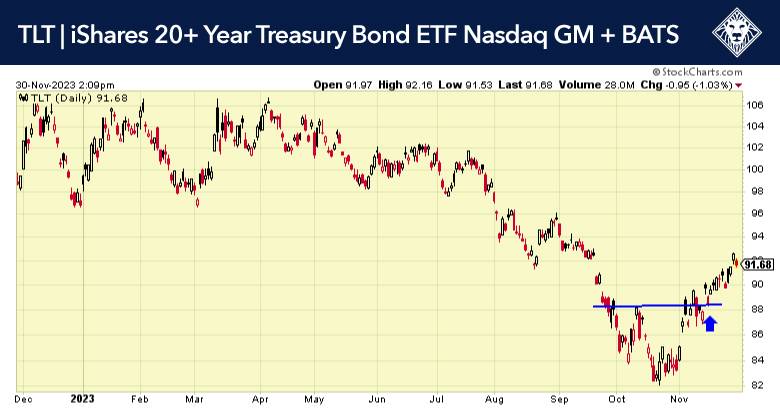
Chart: TLT 1-year daily
Inflation is tracking lower than consensus and the Fed expected. Thus, interest rates could fall next year to prevent “over-tightening.” This would be a positive surprise for markets and could put downward pressure on interest rates, which in turn is good for stocks. Bonds have responded positively, as you can see from the 20-year treasury ETF’s (TLT) pivot up.
The 10-year yield responded to this, falling sharply on Tuesday to 4.334%, the lowest in nearly three months. Similarly, the VIX fell to 12.69, the lowest basically for the year. These two markets exert quite a lot of influence on equities. Thus, it is important to note these moves.
The economy was even hotter in Q3 than previously estimated. Real GDP growth was revised up to a 5.2% annualized rate from 4.9% initially, the biggest gain since Q4 2021, and above the consensus for an unchanged reading. There were notable upward revisions to capex, residential investment, and government spending that were partly offset by a downward revision to consumer spending. On a y/y basis, real GDP was up 3.0%, exceeding the 2.4% gain per annum in the previous expansion.
