

Riding the Wave: Navigating Fed Meetings and Inflation Surprises
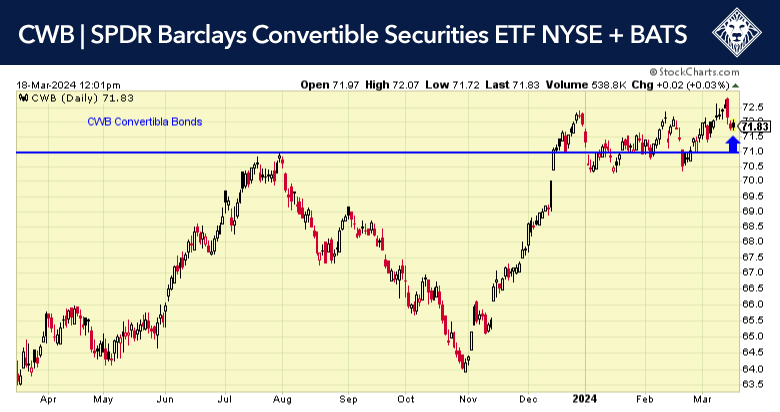
Chart: CWB 1-year daily
The HCM-BuyLine® is positive and pullbacks should be seen as a buying opportunity. Yes, this market does feel a bit overextended as it reaches a nice 20-week run-up, but there is still $6.1 trillion on the sidelines, and that’s a staggering amount of liquidity. The technicals look good and inflows have been positive.
Historically, 10-year Treasury yields have declined from three months before the first rate cut to the first rate cut by a median 72 bps and a minimum of 38 bps. We are 110% for benchmark duration. Long-term support can be found from 5.00% to 5.25%. Short-term support can be found from 4.35% to 4.50%. Short-term resistance is around 3.75%.
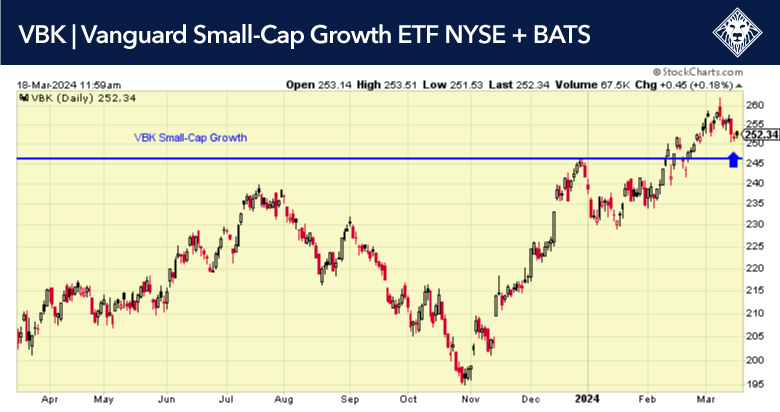
Chart: VBK 1-year daily
The Fed is done raising rates for this cycle, but it will be restrictive for longer. We expect the first rate cut in Q2, probably in June.
This Tuesday and Wednesday the Fed’s Federal Open Markets Committee (FOMC) meets to determine interest rate policy. Chair Powell and most of the “Fed speak” has indicated that there will be no changes in rates at the March meeting.
At the end of the meeting at 2:00pm on Wednesday the Board releases an official statement which gives the rate policy of the Committee. At 2:30 Chair Powell conducts his always important press conference. What makes the Chair’s presser so interesting is that he knows that three weeks later the minutes of the meeting will be released, and any inconsistencies between the Chair’s post meeting comments and the minutes will obviously stir issues for Powell and raise questions at the next post meeting press conference.
CPI inflation came in slightly above expectations in February, driven by higher energy and rent prices. Underlying price pressures showed few signs of easing. The three-month annualized rate of change of core CPI picked up 4.2%, the most since last May. Super-core inflation barely eased to 4.3% y/y from 4.4% y/y in the month before, still running much higher than pre-pandemic. Such firm underlying price pressures are not conducive to Fed rate cuts. Although market expectations still favor the next easing cycle to begin in June, the risk is of later or fewer rate cuts than currently priced in, if inflation pressures persist
The Consumer Price Index (CPI) increased 0.4% in February, the most in six months, and matching the consensus. Food prices were flat, while energy prices rebounded 2.3%, up for the first me since September, led by gasoline. Excluding food and energy, core CPI also rose 0.4%, practically the same as in the prior month, and above the consensus of 0.3%.
