
5.25% Yields: Here Today, Gone Tomorrow?
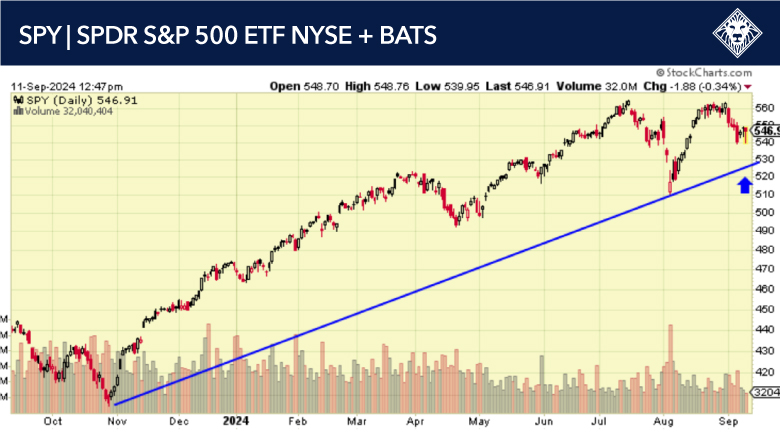
Chart: SPY 1-year daily
Even with all this volatility, the HCM-BuyLine® is positive, and we do expect the August lows to hold. The Fed is dovish, and there is a focus on keeping labor markets strong. We could be seeing some volatility for the next 8 weeks, but this is also in the context of a very strong stock market in 2024, one where the S&P 500 has gained in 7 of the last 8 months.
Q2 GDP growth was revised up to 3.0%, driven by stronger consumer spending at 2.9%. This signals an economic rebound after a slower Q1, with an average growth rate of 2.2% in the first half of 2024. However, easing labor conditions, slowing income growth, and reduced pandemic savings suggest a slowdown in the second half, though 2024 GDP growth is still projected at 1.5%-2.0%, avoiding a recession. Powell’s Jackson Hole speech hinted at potential rate cuts starting at the September Fed meeting, with likely 25 basis point cuts over the next three meetings, or a larger 50 basis point cut if data weakens.
Recent developments have solidified expectations that the Fed will cut rates this month, as indicated by the Federal Reserve’s July meeting and Powell’s Jackson Hole definitively dovish speech. The market is now pricing in at least 75 basis points of rate cuts this year and 225 basis points by the end of next year, signaling a belief in a soft landing. Historically, Treasury yields decline in the three months leading up to the first rate cut. However, there are exceptions when yields bottomed before or shortly after the first cut, notably in 1971, 1995, 1998, and 1984. These four cases had one huge common denominator — they were all non-recessionary easing cycles! If the economy can continue to avoid recession, then there is a good chance that yields are approaching at least a short-term low.
The attractive 5.25% yields on 3-month Treasury bills are temporary and subject to reinvestment risk as rates fall. With rising unemployment and Powell’s growing confidence in controlling inflation, those yields are expected to drop to 3% by next year. Investors are moving into longer-term bonds, but inflows into bond funds haven’t significantly impacted money markets. The bond market tends to anticipate rate cuts, and with increased Fed transparency, it may have already priced in future moves. While yields could drop further, it would require a significantly weaker economy or lower inflation.
