

Beyond “Uncertainty”: Our Plan for a Predictable Uptrend
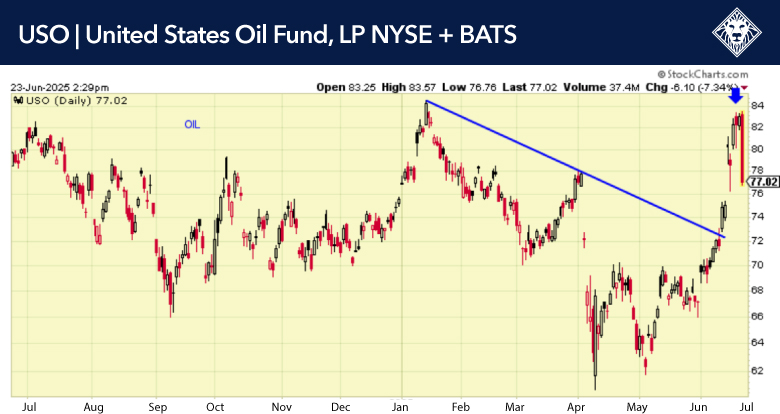
Last week we predicted that the unrest in Iran causing any selloff would be short-lived and any pullback would be buyable, and that seems to be playing out just like we expected. The market is in a solid uptrend, and all pullbacks should be considered buyable until the trend changes. Reduce exposure to oil, as it is now overbought with the turmoil in Iran and should revert back to $60 a barrel if/or after the tension subsides.

One word that has been overused is “uncertainty”. Federal Reserve Chairman Powell has worn that word out. Every time he gets in front of the podium, the key takeaway is that everything is “uncertain”. Well, here is some enlightening news, everything is uncertain. The stock market is uncertain, the economy is uncertain, and when we die is uncertain. If he is truly data dependent, then he should start to drop rates.
But the Fed will be late. We don’t expect the Fed to make any policy changes before Powell’s Jackson Hole speech, presumably on August 22, and the conclusion of the Fed’s longer-run policy review. That puts September as a potential opportunity for a rate cut. The Fed will also need to see additional signs of labor market weakness before cutting rates. That means that the FOMC will be late in reacting to the data. We continue to have a fed funds terminal range of 3.50% to 3.75%.
U.S. economic indicators are slowing down. The Conference Board’s Leading Economic Index (LEI) edged down 0.1% in May, in line with expectations, following a downwardly revised -1.4% in the previous month. The rebound in stock prices from the low in April was the biggest positive contributor to the LEI last month. But that was overwhelmed by relatively large negative contributions from consumer confidence and manufacturing new orders.
The LEI peaked in December 2021 and is now at its lowest level in over a decade. The six-month annualized rate of change worsened to -5.3%, the steepest decline since early 2024. Although this is historically consistent with falling economic activity, the Conference Board does not expect a recession this year.
