Category0

Don’t Blink: History Says January Predicts the Market with 73% Accuracy

12-24-25-SPX

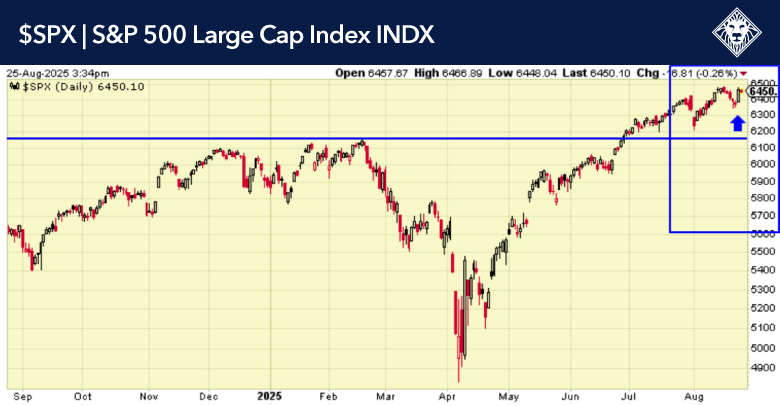
The S&P 500 is very close to hitting our target of 7000 with a few trading days left in 2025. We are bullish in 2026 with our target of 7800. Of course, guessing where the S&P 500 lands brings with it a lot of unknowns, which is the case in any given year. January is critical, let me tell you why. The stock trader’s almanac states that January predicts the year’s course with a .733 batting average. Every down January on the S&P since 1950, without exception, preceded a new or extended bear market, flat market, or a 10% correction. If the S&P gains in January’s first five days, it precedes full-year gains 83.3% of the time. In other words, hope for a good January.
12-24-25-GOOG

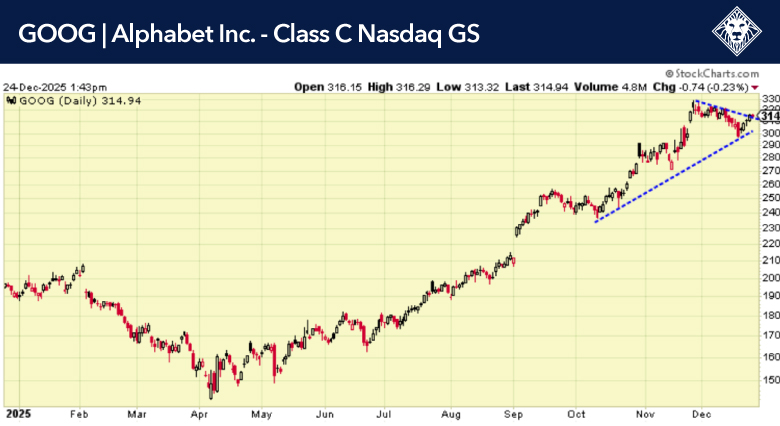
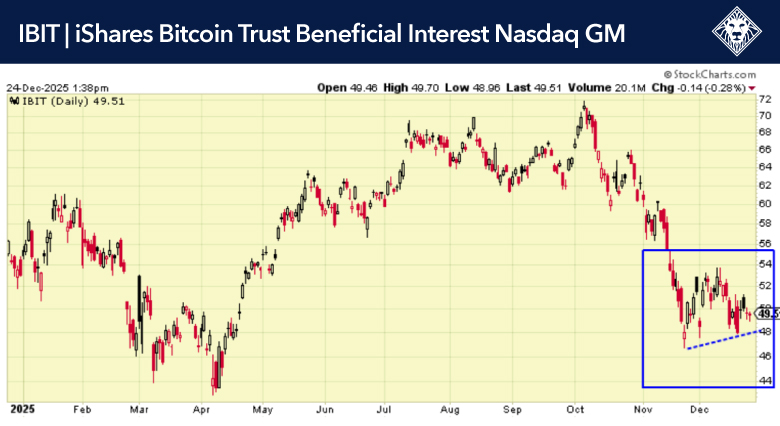
Alphabet Inc. (GOOG) looks like it is ready to break out. And look at IBIT, the iShares Bitcoin Trust ETF, which is re-testing its lows, and it looks like it has based and is ready to move higher. Gold has been moving higher, which we feel is taking away from the Bitcoin trade and we should start to see a rotation back into IBIT.
12-24-25-IBIT

We are hitting the sweet spot-on jobless claims. Initial claims for unemployment insurance fell 10,000 last week to a lower-than-expected 214,000. It was the sixth decline in the past seven weeks, keeping initial claims range-bound since late-2021 and low by historical norms. Despite slower job growth and other signs of the labor market cooling off, the initial claims data suggests that layoffs remain subdued, which is consistent with continued economic expansion.

Real GDP surprised to the upside in Q3, rising at a 4.3% annualized rate, the fastest pace in two years, and above the final GDP estimate of 3.5%. Most major GDP components made positive contributions, led by consumer spending and net exports. Government spending strengthened, and capex growth moderated, while residential investment remained a drag. 

On a y/y basis, real GDP was up 2.3%, staying on track for a solid expansion this year, despite the policy upheaval and a likely dent to output growth in Q4 from the record-long government shutdown.
The Froth Is Gone – An Early Christmas Gift From the Market

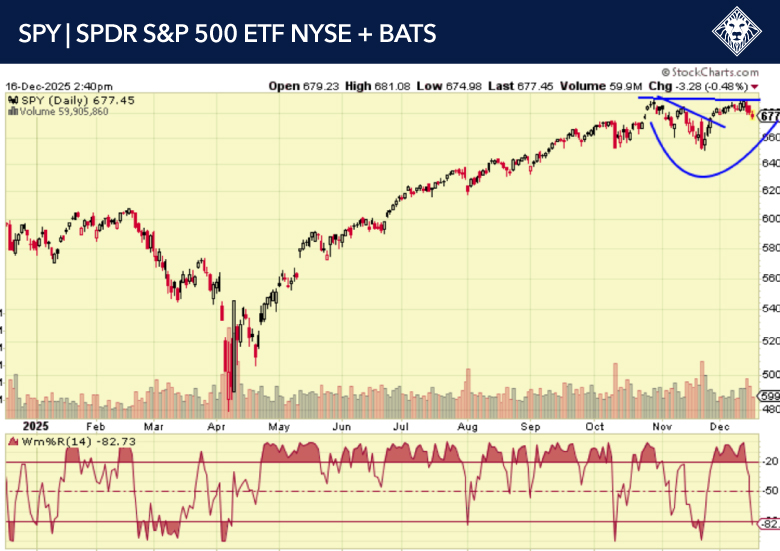
12-16-25-SPY

The S&P 500 has pulled back to where it should now be considered oversold. It has worked off the froth, and this is good for a year-end rally. Look for resistance in the 6870 area, and with a break above 6900 we should get a nice move higher.

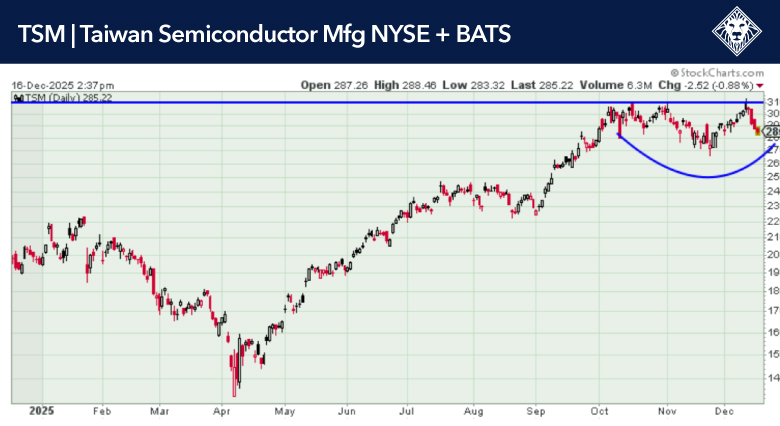
12-16-25-TSM

(TSM) Tiwan Semiconductor is setting up for a cup-and-handle, and we think a break above $312.00 would be a good entry point.

Using a simple sum of the median target price of the companies making up the benchmark S&P 500, analysts are predicting that the index will hit 7,968.78 by the end of 2026 — just shy of 8,000 — according to FactSet. That would be a yearly gain of more than 16% based on Monday’s close at 6,816.51.

Looking ahead at 2026, high valuations pose a threat to tailwinds from the Federal Reserve’s ongoing easing cycle, though Fed Chair Jerome Powell mentioned last week that the Fed was in the range of a neutral rate now. The Fed now expects just one rate cut in 2026.

The Federal Reserve cut its key rate by 25 basis points and stuck to its projection of one more cut in 2026. Chairman Jerome Powell surprised with his assessment that payrolls are falling by 20,000 a month, reflecting what the Fed sees as a 60,000 monthly overcount of the official job numbers. He also said inflation would be running close to 2% if not for tariffs. The Fed said it would begin buying $40 billion of short-term Treasuries, but only to smooth monetary policy, not stimulate growth. Markets see little chance of another cut before March. Meanwhile, the central bank reappointed all regional Fed presidents, easing concerns about central bank independence.


Trump Accounts: How Your Newborn Just Became an Investor

Michael and Susan Dell

First, what a magnanimous, generous gift from Michael and Susan Dell. A donation of 6.25 billion dollars through the vehicle of the new Trump accounts created in this year’s tax bill. It is one of the largest donations ever to go straight to Americans. Many of the details are still being hammered out, but your child may be eligible. You, your employer, and others can deposit money (within certain limits), and it grows tax-free as it would in an individual retirement account.

In this program, the U.S. Department of the Treasury will deposit $1,000 into investment accounts it sets up for American children born between Jan. 1, 2025, and Dec. 31, 2028. The Dells’ gift will use the “Trump Accounts” infrastructure to give $250 to each qualified child under 11.

Under the new law, “Trump Accounts” are available to any American child under 18 with a Social Security number. Account contributions must be invested in an index fund that tracks the overall stock market. When the children turn 18, they can withdraw the funds to put toward their education, to buy a home, or to start a business.

This is one of the best donations I have ever seen, and the Trump Accounts get a newborn invested from day one. They become invested in our markets and our country. Hurray for the Trump Accounts, and a big hurray and THANK YOU to Micheal and Susen Dell. This will change lives.

12-4-25-SPX

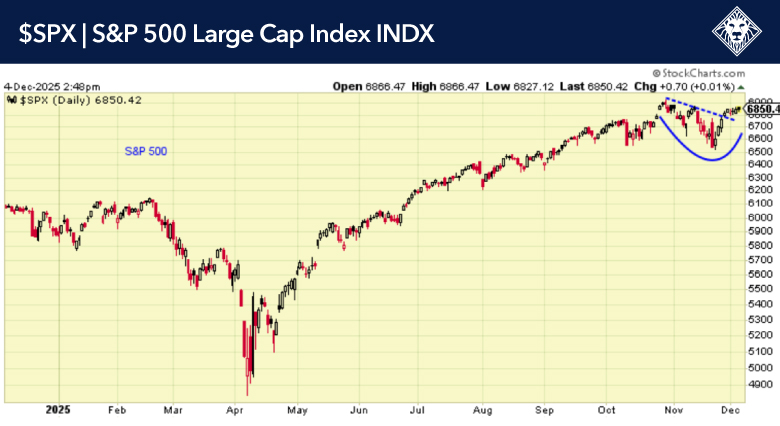
The markets are performing as expected after a pullback of about 5%. As we have said before, this period of consolidation was expected and warranted. Where will we close at year-end? I strongly believe above 7000 on the S&P 500. The S&P 500 broke above a short-term area of resistance and looks like it could be setting up a cup and handle pattern, which would be very positive if it breaks out.

The major indexes surged above their 50-day moving averages, rebounding on Fed rate-cut hopes and more. Leading stocks across a number of sectors showed strength. Google-parent Alphabet (GOOGL) and AI chip partner Broadcom (AVGO) were large-cap winners. The 10-year Treasury yield briefly undercut the 4% level. Bitcoin rebounded above $90,000, though it backed off Friday’s highs.

12-4-25-CRDO

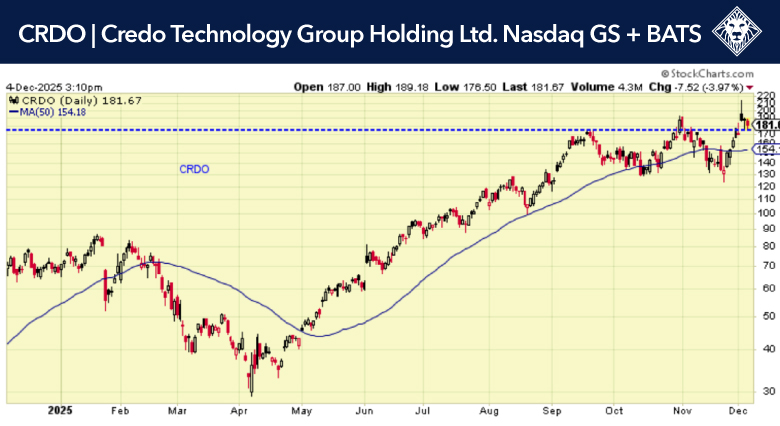
Several high-profile technology names are on the post-Thanksgiving earnings calendar for the coming week, including Snowflake (SNOW), which hasn’t pulled back much as it wages battle near its 10-week moving average. Snowflake is in major growth mode, along with fast-growing artificial intelligence player Credo Technology (CRDO), which reports Monday after the close.


Year-End Market Outlook: Navigating the Chop on the Road to S&P 7000

11-17-25-SPY

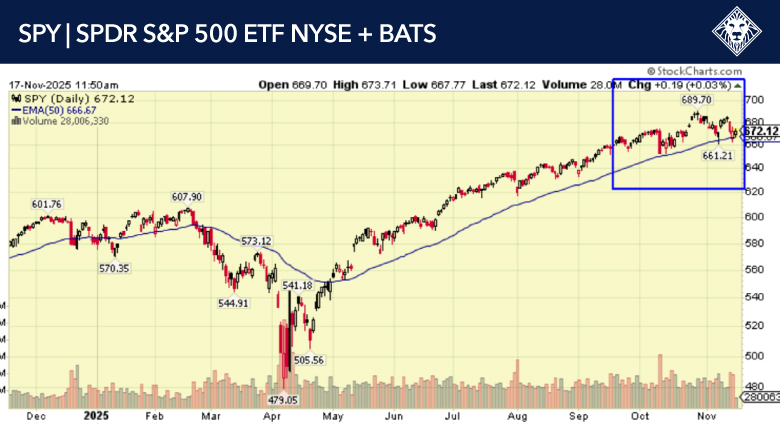
The HCM-BuyLine® is positive, and all pullbacks should be considered buyable. Look for a little bit more chop over the next few weeks. There are only about 6 weeks left in the trading year, and we still see the S&P 500 closing above 7000.

11-17-25-KBWB

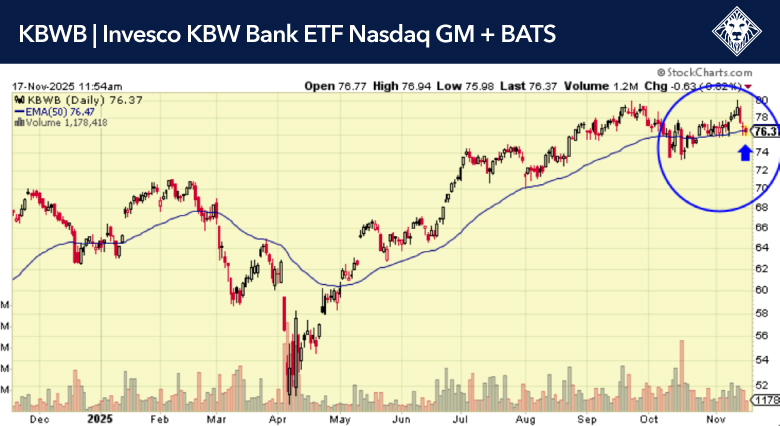
The Invesco KBW Bank ETF (KBWB) is also forming a shallow base with a buy point of 80.04 for now. A sharp pullback earlier this year undercut the lows of a prior base, which served to reset the base count. The fund has risen by just over 18% so far this year, which means it is slightly outperforming the S&P 500. The fund aims to match the performance of the KBW Bank Index. This is a benchmark stock index for the banking sector. It is made up of large U.S. national money center banks, regional banks, and thrifts.

11-17-25-VRT

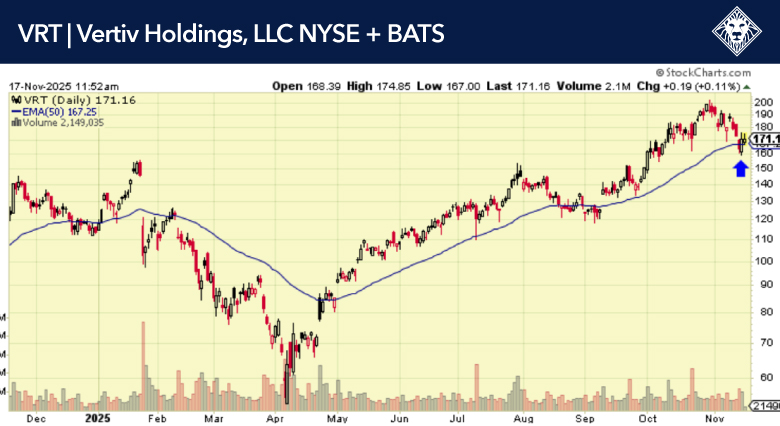
Vertiv (VRT) provides equipment and services for data centers; it manufactures power and thermal management devices, as well as hardware and software. On October 23rd the company announced a 46% jump in third-quarter profit, to 76 cents a share, thanks to the strong AI data center business. Revenue accelerated for a second straight quarter, up 19% to $2.07 billion. Gross margin hit 38%, the highest in at least four quarters. On July 30 the firm reported a 42% increase in EPS to 95 cents as revenue climbed 35% to $2.64 billion. It also guided full-year earnings of $3.80 a share on sales of $10 billion, which was better than analysts expected at the time.

11-17-25-HWM

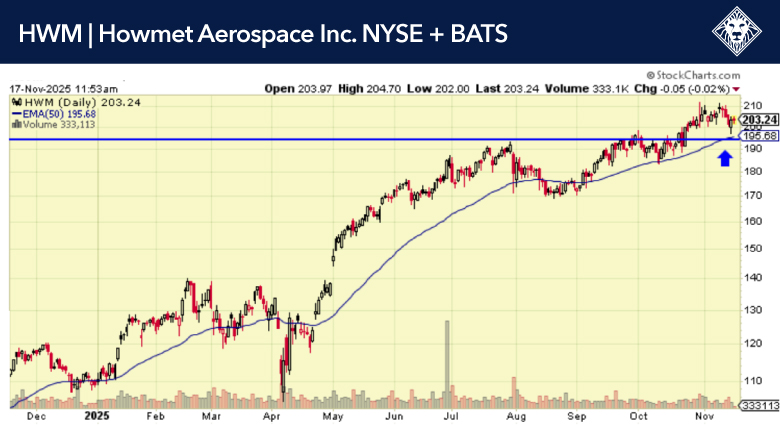
(HWM) Howmet Aerospace provides advanced engineering solutions for the aerospace and transportation industries. It operates in four segments: Engine Products, Fastening Systems, Engineered Structures and Forged Wheels. The company shows a consistent record of earnings and revenue growth. Boeing is a big customer. Annual earnings estimates look solid, with full-year profit expected to rise 35% this year to $3.63 a share and by a further 19% next year.


Dust Off Your Shopping List, BuyLine Still Says ‘Go’

11-7-25-SPX

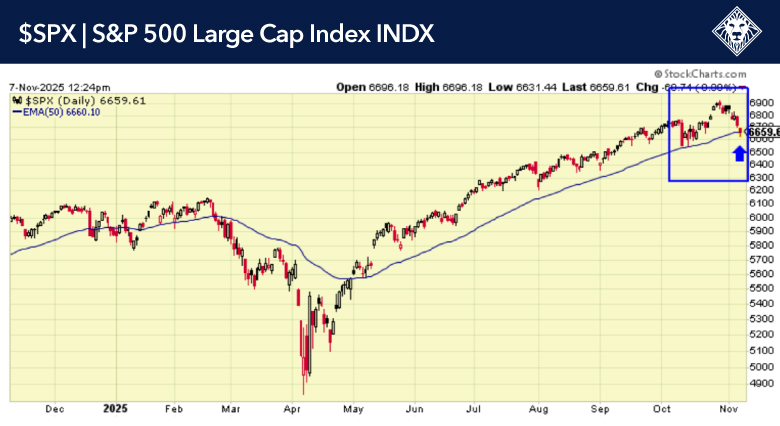
The markets have been pulling back over the last week or so, which looks to be no more than a normal period of consolidation. The S&P 500 and the Nasdaq are both sitting firmly on the 50-day moving average. Pullbacks should be considered buyable as long as the HCM-BuyLine® is positive, so get out your buy list. The markets have now pulled back to the point that they are oversold. Expect the market to continue to consolidate, find its footing, and move higher into year-end.

Investors are trying to process several big factors. The government shutdown, crypto deleveraging, lack of employment and inflation data, and the newly elected mayor of New York City all have people scratching their head.

11-7-25-DAL

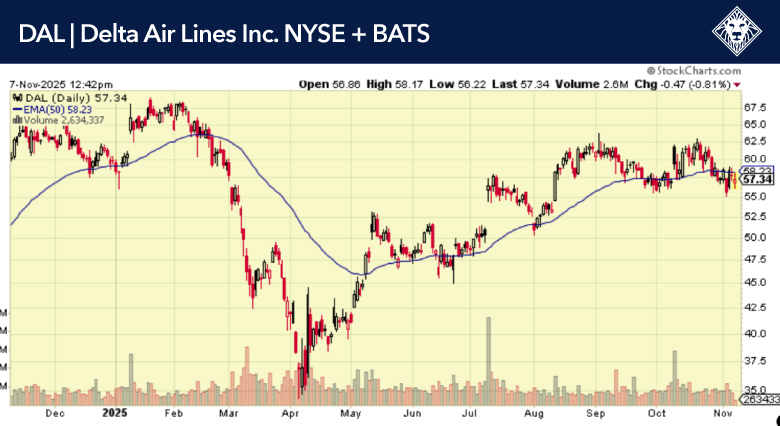
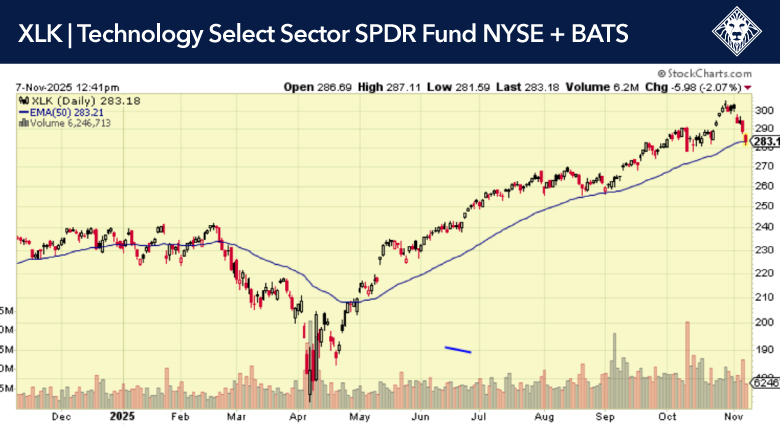
An area to look for opportunities is airlines that are under pressure with the government shutdown. Flights are delayed and cancelled, but this will fix itself soon enough. Another area that looks attractive at current levels is Bitcoin. The Bitcoin ETF (IBIT) has recently sold off and has a lot of liquidity, which makes it easy to make quick moves. Also look at the Technology sector ETF (XLK), as it could be a good way to play the recent pullback.

11-7-25-IBIT
11-7-25-XLK

Is Walmart Sexy Now? How AI Is Turning ‘Boring’ Stocks Into Blockbusters

I know most, if not everyone who reads this is an investor in equities as they should be. But everyone needs to add as much as possible to equities over the coming years. Even with market volatility, and even if we have another bear market. Every advisor should be telling their clients to add on every pullback. And please tell your kids, relatives, friends and anyone who will listen that if they do not invest in equities, the odds of them falling way behind in their retirement and standard of living is going to be devastating. Why? Because AI is here. Unemployment is starting to go up organically, even as the economy is steaming ahead, and corporate profits are racing higher.

If you have not read the news, Amazon just laid off 14,000 employees because AI has made it more efficient and cost effective. Basically, AI is doing the same job as 14,000 employees were at a fraction of the cost. As we all know, an employee is the largest cost to a company, so the fewer you have, the better. This is great for corporate earnings and great for stockholders, but not so great for the unemployed. UPS lad off 34,000 and Salesforce did 4,000. Goldman Sachs laid off 1,300 employees, which is about 4% of their employees. And the list of companies announcing layoffs is growing every day.

10-30-25-WMT

One could do a case study on Walmart. Over the years I have found Walmart to be a bit boring, but not anymore. They’re using AI in a very efficient manner, reducing overhead – meaning employees – and producing outstanding earnings. Look at that chart of (WMT) – that’s as pretty as it gets.

What if over 2-5 years from now unemployment is much higher, but companies are throwing off a 6, 8, 10, or even a 12% dividend due to massive profits? If you have not been heavily investing, start today. For those who are not invested, let’s hope they haven’t missed the boat.


The Bears Were Wrong: Earnings Season’s Triumphant Return

As seasonality is set to exit its most bearish month of the year, we see September as a win. The market has pulled back, which should not be unexpected with how many days the index moved higher. Fortunately, Chairman Powell’s comments did not totally shock the market, except when he gave investment advice about the value of stocks. Can his tenure end fast enough? The HCM-BuyLine® is positive, and we think any pullback should be seen as a buying opportunity until the trend changes. We are bullish going into the last quarter of the year, and we think 6700 or higher is within reason.

9-25-25-HIMS Chart

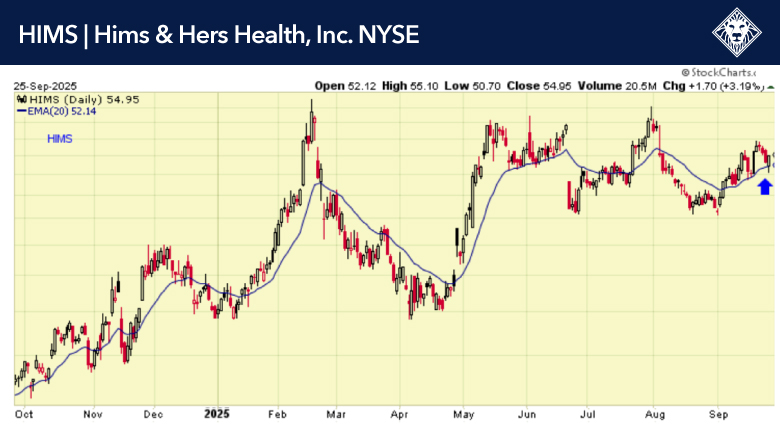
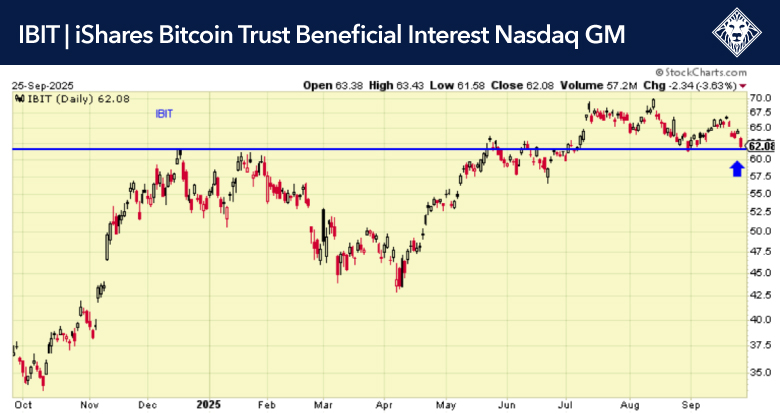
Hims & Hers Health (HIMS) has pulled back and looks to be buyable, along with TD Synnex Corp (SNX), which is breaking out and looks to be gaining momentum. Bitcoin has also pulled back, and we think investors should be looking to buy or add to their position. iShares has a nice Bitcoin ETF (IBIT). If you do not want to buy the coins themselves, the IBIT ETF is highly liquid, and we think it has a lot of bang for its buck.

9-25-25-SNX Chart
9-25-25-IBIT Chart

Stocks have so far not followed the historically weak seasonal trends often seen in September. Instead, the S&P 500 has risen almost 3% month-to-date, with renewed leadership from the growth sectors.

Earnings season has also been strong enough to ease some tariff concerns. Analysts, which slashed estimates following the Liberation Day tariff announcements, were proven to be too bearish. With 98% of companies reporting, the S&P 500’s beat rate has jumped to 81%. Assuming the result is maintained, it will mark the index’s best reading since Q1 2024. Analysts responded by turning more positive and raising 3rd and 4th quarter estimates.


Don’t Fear the Dip: Our Case for Buying Any Pullback

9-15-25-SPX

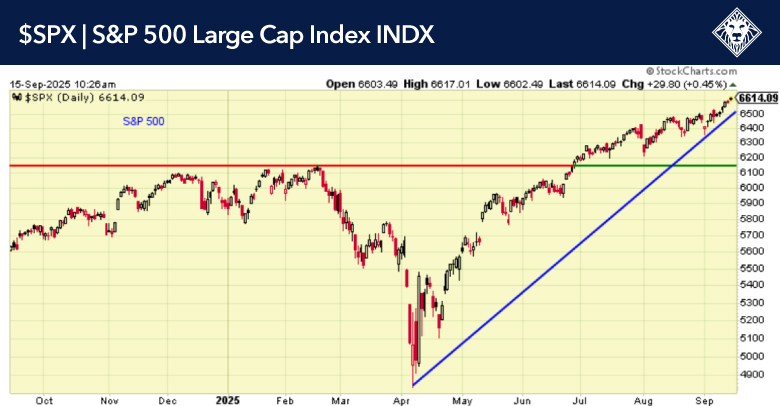
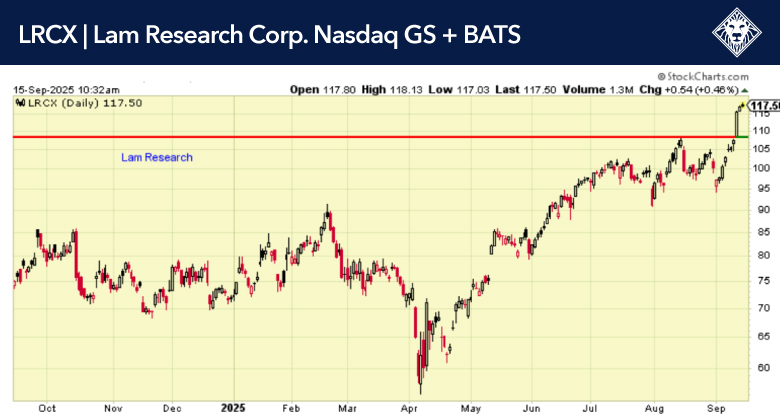
Historically, September and October have not been very good months for the market, but so far in September it is holding up very well. We might expect some volatility over the next 6 weeks, but any pullback should be seen as buyable. I think the last quarter of 2025 could be very strong for the S&P 500, which has already passed 6500, and should reach our prediction of going over 6700 and possibly as high as 7000 by year-end. The markets could have an incredible 5–10-year run. If you’re not heavily invested, we think you should start buying ASAP.

AMD and Lam Research look ready to move higher.

9-15-25-LRCX

An underwhelming employment report secures a September Fed rate cut. Non-farm payrolls increased by 22,000 in August, below expectations of 75,000 and our forecast of 66,000. There was a modest downward revision of 21,000 to the prior two months, in line with our expectations. June now shows a loss of 13,000 jobs, instead of an initial print of 147,000, the first monthly job loss since December 2020. Additionally, the average workweek was unchanged from a downwardly revised 34.2 hours. Average hourly earnings rose 0.3%, matching expectations, but the y/y change eased to 3.7%, below expectations of 3.8%. The unemployment rate ticked up to 4.3%, matching the consensus and our expectation.

This all but secures a 25 bp rate cut at the September FOMC meeting and makes a series of cuts more likely. We have long since argued that a 4.3% unemployment rate would trigger Fed action. We now have that. We have also argued for three rate cuts for most of this year. One 25 bp reduction at each of the next three Fed meetings would fulfill that expectation.

In the establishment survey, private payrolls increased by 38,000 and have averaged just 29,000 in the past three months, the fewest in this expansion. It compares very unfavorably to triple-digit monthly job growth earlier this year, highlighting the dramatic slowdown in job creation amid DOGE, tariffs, deportations, and other policy changes. The trend is consistent with slower overall economic growth, although not a recession at this time.


Is the Fed Listening? Powell’s Dovish Shift Says “Yes!”

The markets are in a solid uptrend, and pullbacks should be considered buyable. Some of the skittishness we saw in markets last week could arguably be attributed to anticipation of Powell’s remarks at the end of the week. But, after a few days of mostly selling, Fed Chair Powell came out a little dovish.

Powell said shifting risks may warrant adjusting the Central Bank’s policy stance. Many investors liked that the Chair is paying greater attention to the labor market, which is much needed because of the recent downward revisions to the jobs report. 

“Overall, while the labor market appears to be in balance, it is a curious kind of balance that results from a marked slowing in both supply of and demand for workers,” he said. “This unusual situation suggests that downside risks to employment are rising. If those risks materialize, they can do so quickly in the form of sharply higher layoffs and rising unemployment.”

New home sales dipped 0.6% in July to a better-than-expected 652,000 unit annual rate, as the prior month was revised up. Even so, new home sales have remained stuck in a range since mid-2022, as high mortgage rates and affordability constraints continue to weigh on demand. A potential Fed rate cut in September could be a catalyst for home sales growth, if indeed it leads to lower bond yields and mortgage rates.

8-25-25-SPX

The S&P Global flash U.S. composite PMI unexpectedly increased (from an already-high reading) in August to 55.4, its best level this year.

The upside surprise came mostly from the manufacturing sector, which unexpectedly bounced back into expansion mode, jumping to 53.3, a 39-month high. Almost all components and individual indexes jumped, including large gains in new orders (including export orders), output, and employment. Finished goods inventories grew at the fastest pace on record, as businesses expressed worry about future supply conditions amid government policy and tariff risks.

The services sector also grew robustly, albeit slightly less so, as the PM edged down to 55.4. New business (including exports) rose to the highest this year, while employment climbed to a seven-month high.