Category0

Sector Spotlight – Let’s Talk Financials, Airlines, And Bitcoin

The HCM-BuyLine® is positive, and a pullback should be seen as buyable. We have 18 days left until the election and it’s anybody’s guess as to who will win. Look for the market to either get very slow, meaning not a lot of movement, or on the other hand a lot of volatility as traders and investors try to game the outcome.

10-18-24-TLT

Chart: TLT 1-year daily

As the chart shows, the 20-year bond ETF (TLT) has dropped significantly, and a tradable opportunity could be setting up. Rates have risen organically but are now overbought and a snapback rally could be in the making. 10-year yields are responding appropriately to their recent overbought conditions. Remember, overbought conditions in downtrends tend to be more effective than overbought conditions in uptrends, so we like what we’re seeing.

10-18-24-USB
10-18-24-USB2
previous arrow
next arrow

Charts: USB, MS, DAL & JETS 1-year daily

Several positive volatility alerts were triggered in financials on Wednesday, look at U.S. Bancorp (USB) and Morgan Stanley (MS) which are breaking out to the upside. But, we are also seeing some improvement in the airlines with both (DAL) Delta Airlines and the Global Jets ETF (JETS) which are showing positive breakouts from big base formations.

10-18-24-IBIT

Chart: IBIT 1-year daily

Also, the iShares Bitcoin ETF (IBIT) is trying to move higher. If we can get a breakout above $40/share look for Bitcoin to make a strong move to the upside. If you watch Bitcoin, it will bring out the bullish spirits of a lot of investors and traders when it starts to move higher.
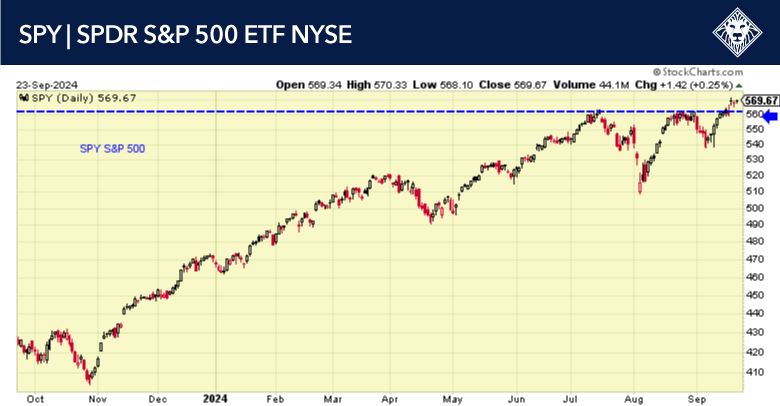

S&P 500 Reaches New Heights, But Beware Of Election Volatility

9-24-24-SPY

Chart: SPY 1-year daily

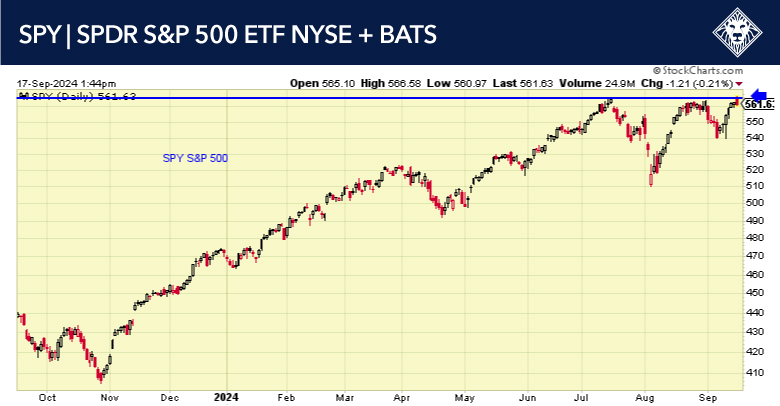
The large-cap S&P 500 index broke above resistance of its slightly downward-sloping trendline. An all-time high is one of the best indicators you can have for a very strong market. The HCM-BuyLine® is also strong, and the trend is pointing up. However, as the election approaches, we do see a good chance for increased volatility to affect the markets.

9-24-24-TLT

Chart: TLT 1-year daily

The tech-heavy Nasdaq has also broken above resistance of its downward trendline, but, unlike the S&P 500, it didn’t close at a new all-time high this week. Its market breadth isn’t as strong as that of the S&P 500.

9-24-24-COMPQ

Chart: $COMPQ 1-year daily

Bond prices have fallen since the Fed’s decision, possibly because the stock market is still coming to grips with the news. The chart of the iShares 20+ Year Treasury Bond (TLT) shows that TLT is close to a support level.

So, the first Fed rate cut is behind us, and we are no longer in a “higher for longer” period, but in a new rate cut cycle which will most likely last well into 2025. So that’s good news for stocks, right? Well, not necessarily.

The reality is that rate cut cycles do not happen very often. On average, there’s one rate cut cycle about every ten years. This is because the Fed raises and lowers rates in line with the economic cycle. When the economy is growing, they can raise rates to keep growth in check. And when the economy starts to slow down, they can lower rates to encourage spending and economic growth.

But if history provides any lesson here, it’s that a rate cut cycle has usually been very good for stocks, but not always immediately. Mindful investors should remain vigilant, watching for signs of a potential downtrend, and focusing on areas of the market still showing relative strength in light of market uncertainties.


Fed’s Big Move – Are The Markets Set to Soar?

9-17-24-QQQ

Chart: QQQ 1-year daily

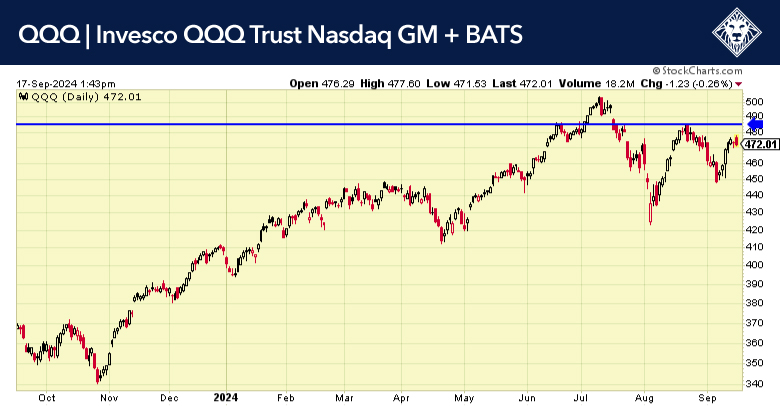
All eyes are on the Fed as a rate cut decision is about to be announced. The HCM-BuyLine® is positive, and a breakout looks like it could be on the horizon. If the QQQs can break above $485, it would be a very strong sign that we are headed for new highs on the NASDAQ, and if SPY can break out above $565, it will mean a new all-time high for the S&P 500. We expect both. We are not sure how fast it will happen, but we feel confident new highs are coming our way.

9-17-24-SPY

Chart: SPY 1-year daily

Following last week’s CPI report, the market had resigned itself to a 25 bp cut. But Powell has been patient, and the Fed wanted to have greater confidence that inflation would return to its 2% target.

In his Jackson Hole speech, Powell pivoted toward focusing more on the employment side of the dual mandate. His confidence had “grown that inflation is on a sustainable path back to 2%.” He proclaimed, “It seems unlikely that the labor market will be a source of elevated inflation pressures anytime soon. We do not seek or welcome further cooling in labor market conditions.”

As always, the timing and pace of rate cuts will depend on three factors. First, the incoming data must be consistent with achieving the Fed’s inflation target. However, the employment data has softened, with payrolls being revised lower and the unemployment rate coming in higher than previously expected. Second, the outlook is uncertain, especially with the elections seven weeks away. Third, the balance of risks is even more clearly tilted to the downside for employment.


5.25% Yields: Here Today, Gone Tomorrow?

9-11-24-SPY

Chart: SPY 1-year daily

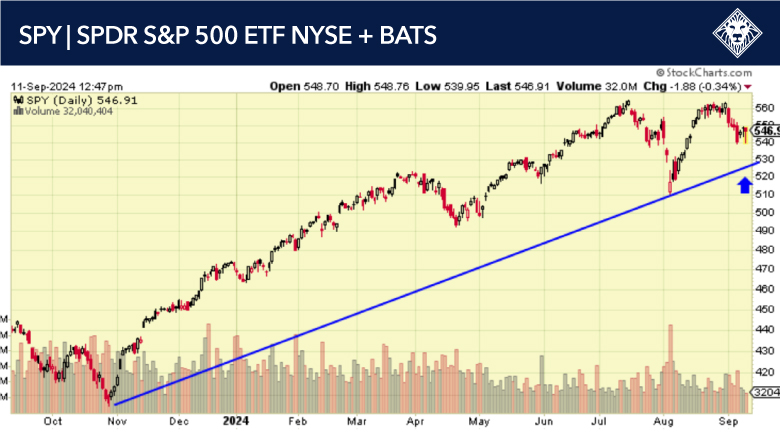
Even with all this volatility, the HCM-BuyLine® is positive, and we do expect the August lows to hold. The Fed is dovish, and there is a focus on keeping labor markets strong. We could be seeing some volatility for the next 8 weeks, but this is also in the context of a very strong stock market in 2024, one where the S&P 500 has gained in 7 of the last 8 months.

Q2 GDP growth was revised up to 3.0%, driven by stronger consumer spending at 2.9%. This signals an economic rebound after a slower Q1, with an average growth rate of 2.2% in the first half of 2024. However, easing labor conditions, slowing income growth, and reduced pandemic savings suggest a slowdown in the second half, though 2024 GDP growth is still projected at 1.5%-2.0%, avoiding a recession. Powell’s Jackson Hole speech hinted at potential rate cuts starting at the September Fed meeting, with likely 25 basis point cuts over the next three meetings, or a larger 50 basis point cut if data weakens.

Recent developments have solidified expectations that the Fed will cut rates this month, as indicated by the Federal Reserve’s July meeting and Powell’s Jackson Hole definitively dovish speech. The market is now pricing in at least 75 basis points of rate cuts this year and 225 basis points by the end of next year, signaling a belief in a soft landing. Historically, Treasury yields decline in the three months leading up to the first rate cut. However, there are exceptions when yields bottomed before or shortly after the first cut, notably in 1971, 1995, 1998, and 1984. These four cases had one huge common denominator — they were all non-recessionary easing cycles! If the economy can continue to avoid recession, then there is a good chance that yields are approaching at least a short-term low.

The attractive 5.25% yields on 3-month Treasury bills are temporary and subject to reinvestment risk as rates fall. With rising unemployment and Powell’s growing confidence in controlling inflation, those yields are expected to drop to 3% by next year. Investors are moving into longer-term bonds, but inflows into bond funds haven’t significantly impacted money markets. The bond market tends to anticipate rate cuts, and with increased Fed transparency, it may have already priced in future moves. While yields could drop further, it would require a significantly weaker economy or lower inflation.


Market Rally Gains Momentum Amid Fed Rate Cut Expectations

8-27-24-SPY

Chart: SPY 1-year daily

The HCM-BuyLine® is positive as the trend is firmly back up. After a very hard and straight down drop on the first of the month, the markets have moved back to being close to all-time highs. The selloff was fast and hard, but defiantly worked off the over bought condition. The S&P 500 is now hitting a bit of resistance, but we do expect it to break out in the very near future.

8-27-24-VNQ

Chart: VNQ 1-year daily

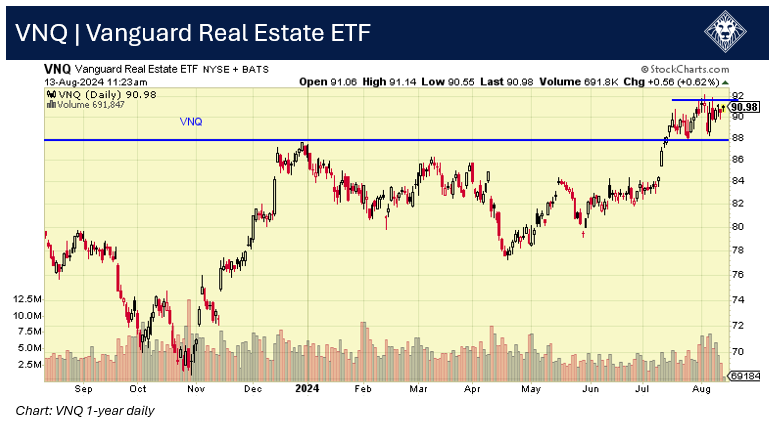
Bonds are looking much better and could be a nice investable asset after an almost two-year beating. With lower rates on the horizon, bond prices should move higher as rates move lower. Real Estate has broken out, which is to be expected with lower rates – this should increase earnings. We are watching for small caps to make a move higher. Lower rates will help small caps’ lower borrowing cost, which should also increase earnings.

Powell signals a shift in policy direction – his Jackson Hole speech leaned dovish but overall was very much in line with our market expectations. The Fed will embark on a rate cutting cycle at its next meeting. Powell has previously said that the first cut is consequential, implying a series of rate cuts. He said, “The time has come for policy to adjust. The direction of travel is clear…”

Powell has pivoted to focus more on the employment side of the Fed’s dual mandate, saying he does not want to see a further weakening in the labor market. With unemployment close to longer-run estimates of full employment, that provides an asymmetric response to incoming data. Our base case remains 25 bp of rate cuts at each of the next three FOMC meetings, but should data come in weaker than expected, we could see a larger 50 bp cut.

Powell is more confident that inflation will come down back to target. What Powell didn’t say is where the Fed is heading or how fast it will get there. There was no mention of r-star or where the target range will be at the end of this year or next year. The Fed remains data dependent, so unexpected data will result in a large repricing of interest rate expectations. The market is currently priced for more than 75 bp of rate cuts this year and 225 bp of rate cuts by the end of next year. The market is already priced for a soft landing and getting back to close to neutral by the end of next year.


Beyond the Flash Crash: Finding Value Amidst Market Uncertainty

The HCM-BuyLine® came close to a trend change last Monday after the flash crash. It did stop us out of several positions as our walk behind, HCM Pivot Points® was hit, bringing us to over a billion in cash. Has the market bottomed? In all probability, yes, but there has been a lot of technical damage done, and it will not repair itself fast. We should see a retest of the lows seen on 8/5. The market is about to hit a point of resistance, so patience is needed at this time. We might not see a total retest, but the market should pull back for a period as investors catch their breath and evaluate the situation.

We are being patient, and we will let the market pull us back in when a new HCM Pivot Point® emerges. There are a lot of options that will present themselves as the selloff brought a lot of stocks down to very attractive valuations.

Last week’s flash crash tightened financial conditions. The meltdown was primarily caused by the unwinding of the carry trade following central bank decisions the week before. Stress rose due to the unwind of the carry trade. A lack of liquidity in the banking system and in trading markets added to the outsized moves.

The jump in the Financial Stress Index was almost solely due to “Other Advanced Economies” like Japan. That means the spike in the FSI was due to the unwinding of the “carry trade,” where traders would borrow in yen and invest in risk assets around the world. Traders were simply overexposed to carry risk.

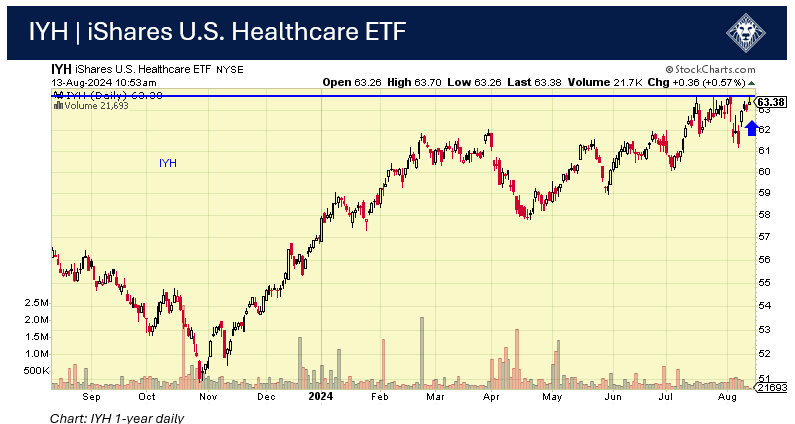
Health Care Sector (IYH) is setting up nicely; some health care stocks that look strong are (REGN) Regeneron and Eli Lily (LLY). Also, real estate has held up strong and looks ready to break out. VNQ is the Vanguard real estate ETF, and it also looks ready for a breakout. Lower interest rates will help real estate with lower cost to own property increasing earnings.


VIX Hits the Roof: Is This Selloff Overdone?

8-5-24-VIX

Chart: VIX 3-year daily

As we have stated in the last several Wealth Watches, a pullback was needed as the market had gotten ahead of itself. The first pullback looked like a classic period of consolidation, but Friday’s job report sent the markets reeling as the word “recession” poked its ugly head up again.

The fear index, the VIX, reached a very extreme high, noting that capitulation was taking place. Has the selloff been overdone? In our opinion, yes, and a lot of technical damage was done, so it will take some time and volatility before it corrects itself.

Last Thursday, and Friday, a few of our stops were hit, and cash was raised by roughly $1 billion. If the market continues to fall, additional stops will be hit, and more cash will be raised. This gives us a lot of buying power when the market does turn back to the upside, which we expect it to do.

After selling off like this, look for the market to stage a shorter-term rally and then sell off a bit more before retesting the lows. That should set up a new base for the market to work higher from.

Remember, markets routinely have 10% corrections, even in bull markets. Again, equity indices suffered technical damage, and it will take some time to repair.

Some brief things to think about as to why the selloff occurred: Seasonals are poor for August historically. The July jobs report raises concerns that the Fed is “too late.” The Bank of Japan raised policy rates to +0.25%, the highest since the GFC. Geopolitical risks heightened in the Middle East. Large-cap rotation out of MAG7 is causing “portfolio pain.” The 2024 Presidential election has tightened dramatically since the debates.


Jobs Report Jitters – is Recession Looming?

8-2-24-QQQ

Chart: QQQ 1-year daily

The markets have sold off hard in the last week or so. As we mentioned in the last Wealth Watch, a pullback was warranted since the market had become way overbought. With the jobs numbers this morning, what should have been a normal pullback turned into a selloff that hit some of our stops and moved a portion of equities to cash. Investors are now worried. Are we heading for a recession?

The markets will probably trade a bit lower and slop around, scaring everyone before finding a base and starting to move higher. We will strive to re-buy on the turn back up. There will be some nice opportunities that come out of this selloff. Is the bull market over? In our opinion, no. Selloffs like this happen on a somewhat routine basis, and there is still a lot of road left in this year’s market.

8-2-24-TLT

Chart: TLT 1-year daily

The US unemployment rate unexpectedly rose from 4.1% in June to 4.3% in July. The economy added 114,000 jobs, less than economists had predicted. The new jobs report on Friday comes after the Fed decided to hold rates steady. The unemployment rate unexpectedly jumped in July, climbing to 4.3% from 4.1%.

US nonfarm payrolls also came in light, with the economy adding 114,000, missing the consensus expectation of 176,000. The Bureau of Labor Statistics also revised May and June job additions lower. The weak report all but confirms the Federal Reserve will cut interest rates in September, an outcome that was already a near 100% probability.

During a Wednesday press conference, Fed Chair Jerome Powell said of the outlook for rate cuts later this year that he “can imagine a scenario in which there would be everywhere from zero cuts to several cuts, depending on the way the economy evolves.”

“The question will be whether the totality of the data, the evolving outlook, and the balance of risks are consistent with rising confidence on inflation and maintaining a solid labor market,” Powell said. “If that test is met, a reduction in our policy rate could be on the table as soon as the next meeting in September.”


Election and The Bull Market – An Unusual Dance

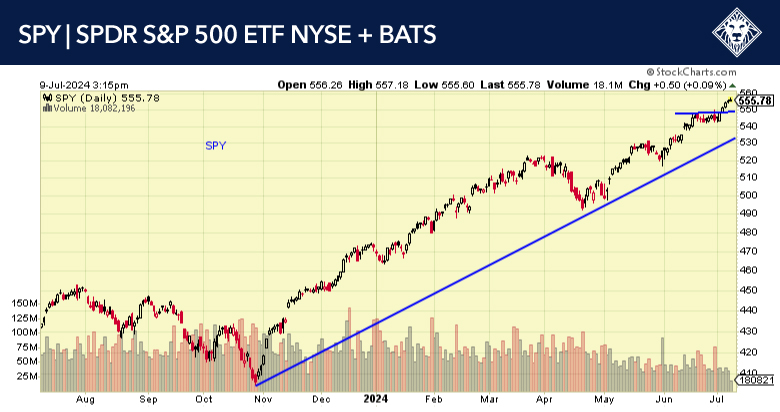
7-10-24-SPY

Chart: SPY 1-year daily

The S&P 500 is in its 11th longest stretch without a 2% down day since 1928. No doubt the market is overbought, but when will it turn, and by how much? We are in a strong uptrend as identified by the HCM-BuyLine® and all pullbacks should be considered buyable, and a pullback is warranted so there should be no surprise when it happens.

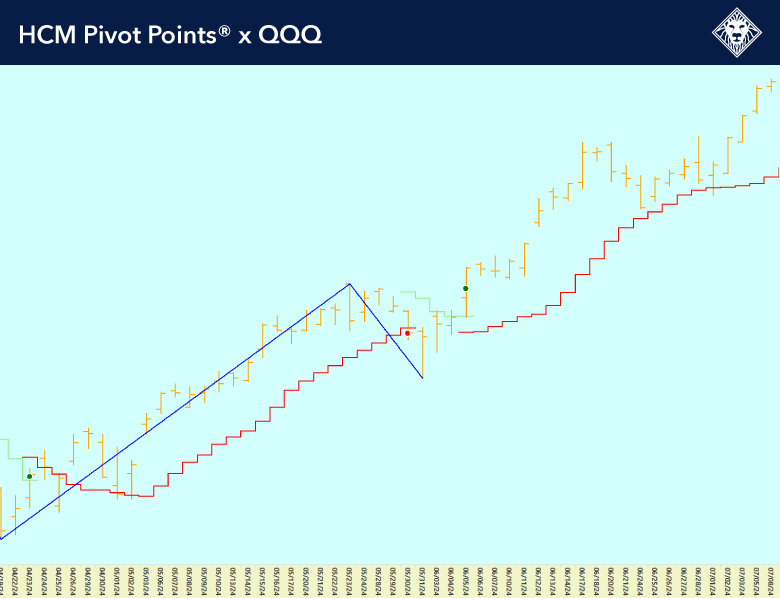
7-10-24-HCMPPxQQQ

Chart: QQQ x HCM Pivot Points® 3-month daily

This has been a very interesting week after the most disturbing debate, well, maybe ever. They are lining up for President Biden to step aside, but he is clearly anchored in. This is what I find most interesting, in all my years of trading the markets I have never seen this much discord in a political debacle or instability in the leader of the US, yet the market is going up. It has been marching higher almost every day after the debate. I’m not sure what to make of it. In almost all other cases the market has become volatile and usually traded down. All I can make of it is that the markets are OK with Biden stepping down. It would be almost humorous if it was not so serious as to who is leading our country, especially when you have leaders like Xi Jinping, Vladimir Putin, Kim Jong-un, Ismail Haniyeh, and the list goes on of people that would like to destroy us.

The Conference Board’s Employment Trends Index (ETI) resumed its decline in June, falling 0.7% from the prior month and is down 2.1% from a year ago. The ETI has trended down since its peak in March 2022 and is now near its lowest level in over three years. It had generated a signal for slower payrolls growth back in March 2023, which is what has transpired in the payrolls data. Its current level and trend point to further moderation in 2H 2024. The Conference Board, however, highlighted that “net nonfarm payrolls are likely to remain positive,” as long as layoffs remain low. This is in line with our outlook for slower payrolls and economic growth in the coming months. 

The New York Fed’s Survey of Consumer Expectations showed inflation expectations mostly easing in June. The one-year inflation outlook came down to 3.0% from 3.2%, while the five-year outlook moderated to 2.8% from 3.0%. The intermediate three-year outlook edged up slightly to 2.9% from 2.8%. Importantly, inflation expectations across all three time horizons have eased significantly compared to earlier in this cycle and have been range-bound so far this year, albeit at higher levels than pre-pandemic.