Category0

Bullishness Abound – Is It Time To Broaden Out?

6-25-24-NVDA

Chart: NVDA 1-year daily

Is the market overbought? Yes, but the uptrend is still intact. Is a pullback warranted? Yes, and we will probably have a modest selloff soon. But we do think it will be a buyable pullback as the bull market is still very much alive. Nvidia (NVDA) is all you hear about, which is justifiable, but as Nvidia sells off it looks like the money is going into other areas of the market, which is very bullish. Inflation is dropping and earnings have been very good. There is over 6 trillion in cash on the sidelines, and even with the market moving higher that amount has hardly changed, so there is still lots of buying power to fuel the markets higher.

6-25-24-SPY

Chart: SPY 1-year daily

Private sector business activity continued to expand in June, with the S&P Global Flash U.S. Composite PMI edging up 0.1 point to 54.6, its highest level since April 2022. The index is up 2.6 points in Q2, the biggest three-month gain in over a year, a sign of accelerating growth and a tailwind for stock prices

6-25-24-SPYxHCMPP

Chart: SPY x HCM Pivot Points® 3-month daily

Both services and manufacturing activity picked up this month. The flash Services PMI rose 0.3 points to 55.1, the highest level in 26 months, and above the consensus of 53.7. New orders rose at the fastest rate in a year, driven by strong domestic demand. Export orders continued to fall, but at a slower pace. Employment increased at the fastest clip in five months. Even so, backlogs rose which suggests that lingering labor supply issues are likely weighing on firms’ operating capacity

The flash Manufacturing PMI rose 0.4 points to 51.7, a three-month high, and above the consensus of 51.0. As in services, new orders and employment rose at faster rates than in recent month. Order backlogs were nearly flat. Output growth, however, moderated.

Existing home sales fell 0.7% in May to a 4.11 million unit annual rate, a four-month low, but slightly better than the consensus estimate of a 4.10 million unit rate. Sales have declined most of the time since late 2021, including in the past three months. There are, however, nascent signs of stabilization. The latest decline was smaller than in the prior two months. Also, sales were flat in three of the four regions, falling only in the South. Compared to a year ago, sales were still down 2.8%, a near-steady rate for the past five months and close to the slowest pace of decline since January 2022.


Steering Clear of Recession Waters – Is The Fed’s Parachute Ready?

6-13-24-SPY

Chart: SPY 1-year daily

The markets are making a very nice jump up this week. CPI and PPI came in at levels that suggest a slowing economy. The Fed will need to be awake at the wheel so as not to throw us into a recession. We have been positioned well with the current run up. Commodities, or hard assets, were leading the way early this year, but that has switched as hard assets are slowing, and tech and growth stocks are now taking the lead.

Following a softer-than-expected May CPI inflation report yesterday, producer price inflation also surprised to the downside today. It provides a reprieve from faster price growth in the first few months of this year and suggests that PCE inflation, which is the Fed’s target, will also likely ease. Continued moderation in inflation creates room for a Fed rate cut later this year.

On Fox Business last week, we mentioned the market is broadening out and we are looking at other areas outside of the Magnificent Seven that have the potential to be very strong investments. As yields and inflation comes down, we anticipate investors to come off the sidelines and participate more in market.

6-13-24-QQQ

Chart: QQQ 3-month daily

The Producer Price Index (PPI) for final demand fell 0.2% in May, the most in seven months, and contrary to the consensus of a 0.1% gain. It was driven by a 4.8% drop in energy prices, also the most in seven months. Gasoline, specifically, fell an even larger 7.1%. Food prices slipped 0.1%, down for the second consecutive month. PPI ex-food and energy ticked up by less than 0.1%, below the consensus of 0.2%.

Core goods PPI rose 0.3%, while services PPI was flat. Within services, trade margins edged up 0.2%, but transportation and warehousing prices fell 1.4%, the most in over a year.

On a y/y basis, PPI edged down to 2.2% from 2.3% in the prior month, while core PPI eased to 2.3% from 2.5%. Pipeline price pressures, however, were mostly up across the production flow, posing a risk to further disinflation.

Additionally, the PPI for final demand personal consumption also picked up to 2.8% y/y, the most since February 2023. This PPI aggregate correlates strongly with the CPI, and its near-term trend suggests CPI inflation may struggle to come down in the months ahead.

Initial claims for unemployment insurance increased 13,000 last week to 242,000, contrary to the consensus of a modest decline to 225,000. This was the third consecutive rise, pushing up claims to the highest level since August 2023. The four-week average picked up 4,750 to 227,000, the highest read since last September. Although the level of claims is still within its two-year range and low by historical norms, the recent pickup suggests some softening in labor demand.


Bond Market Whispers – TLT’s Clues To Economic Winds

The markets are still positive and the HCM-BuyLine® remains in an uptrend. With that said, it is starting to look and feel a bit top-heavy. News on inflation has been, as they say, sticky, but there have also been areas where inflation looks like it might start to crack. If so, look for the bond market to rally as interest rates should drop organically with the anticipation of the Fed lowering rates.

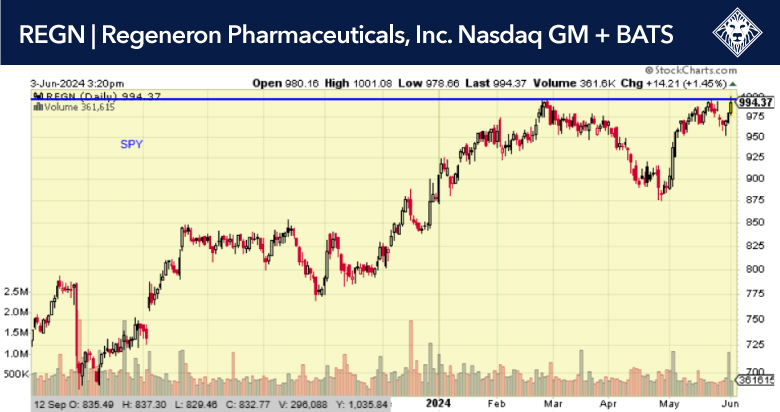
6-4-24-REGN

Chart: REGN 1-year daily

Biotech has been trading better, as identified by IBB, the iShares Biotech ETF which crossed back above its 50-day moving average. Three biotech stocks that look attractive to us are Merck (MRK), Regeneron (REGN), and Moderna (MRNA). From a technical point of view, all three look poised to move higher.

6-4-24-CRM

Chart: CRM 1-year daily

Salesforce (CRM) took it on the chin last week with a nasty drop. The drop came after Wednesday when Salesforce reported fiscal first quarter results that missed Wall Street’s revenue estimates for the first time since 2006. It also gave lighter-than-expected guidance. The stock should re-test the lows set last week around $216/share, which could be an area to look to buy. Salesforce could be a very big winner in the development of AI, and they have a very reliable monthly subscription revenue.

6-4-24-TLT

Chart: TLT 1-year daily

The 20-year Treasuries are in a clear downtrend, but any news that inflation might be softening will move bonds higher, and probably at a fast pace. Look how TLT is starting to make a short-term higher low. It’s early, but everyone should be watching the bond market, as it will probably tell us a lot about where inflation is headed. If TLT breaks above that line of resistance, look for a fast move back up to the $100 area.

Q1 real GDP growth was revised down to a 1.3% annualized rate from 1.6% initially, slightly better than the consensus estimate of 1.2%. It was led by softer consumer spending (mostly on durable goods) and a deeper decline in inventory investment that was partly offset by stronger state and local government spending and higher residential investment than previously estimated.

Pending home sales plunged 7.7% in April, much worse than the consensus estimate of -.4%. It was the first decline in three months and the most since February 2021, taking contract signing activity to a new record low since data started in January 2001. Pending sales fell across all four regions. It suggests that existing home sales will remain under downward pressure in the near term. High mortgage rates, rising home prices, and limited housing inventory continue to weigh on housing affordability and sales.


Dip, Buy, Soar – Post-PCE Predictions

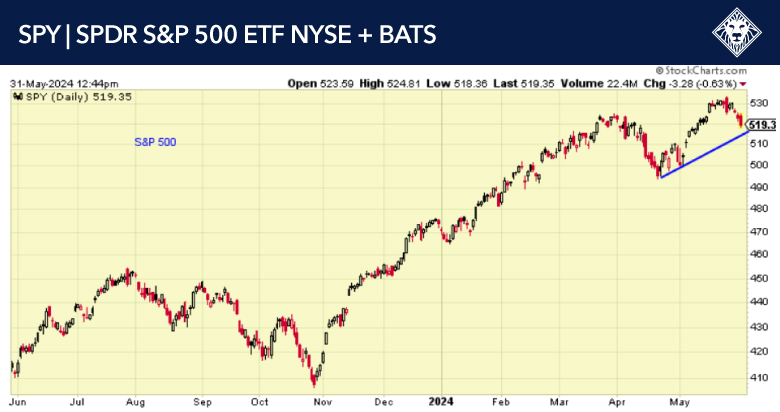
5-31-24-SPY

Chart: SPY 1-year daily

The markets have sold off, making it three down days in a row if today closes lower. In our opinion this should be seen as an opportunity to buy or add to your positions. The HCM-BuyLine® is strong, and the trend is clearly up, so all pullbacks should be considered buyable at this point.

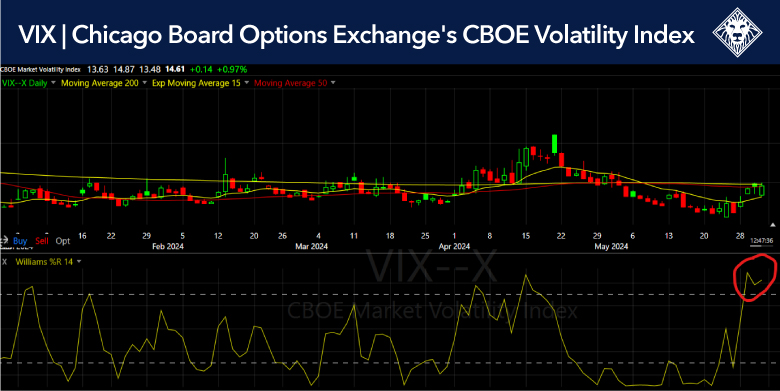
5-31-24-VIX

Chart: SPY 1-year daily

As you can see from the VIX index, the market is now oversold, and we do expect a rally over the next few weeks. Stocks have typically performed well after the release of the PCE numbers. In fact, four out of the last four times PCE numbers have come out, stocks were higher a week or so later.

Personal Consumption Expenditures (PCE), the final economic report on the final day of the month of May, was in-line with expectations almost completely across the board. Personal Income came down 20 basis points (bps) month over month to +0.3%, as expected. Personal Spending, the only metric to break with estimates, came in at a cooler +0.2% (+0.4% expected), from a downwardly revised +0.7% in March.

Inflation is headed in the right direction, not at a fast pace, but still in the right direction. Initial claims for unemployment insurance ticked up 3,000 last week to 219,000, about in line with the consensus estimate of 218,000. They have been range-bound near this level since late-2021, reflecting robust labor demand and an ongoing economic expansion.  The Fed has to be very careful at this point because unemployment has ticked up just slightly, and I’m sure they are monitoring that.

Q1 real GDP growth was revised down to a 1.3% annualized rate from 1.6% initially, slightly better than the consensus estimate of 1.2%. It was led by softer consumer spending (mostly on durable goods) and a deeper decline in inventory investment that was partly offset by stronger state and local government spending and higher residential investment than previously estimated.


May Flowers Could Be On The Way – Is NVIDIA Set To Soar?

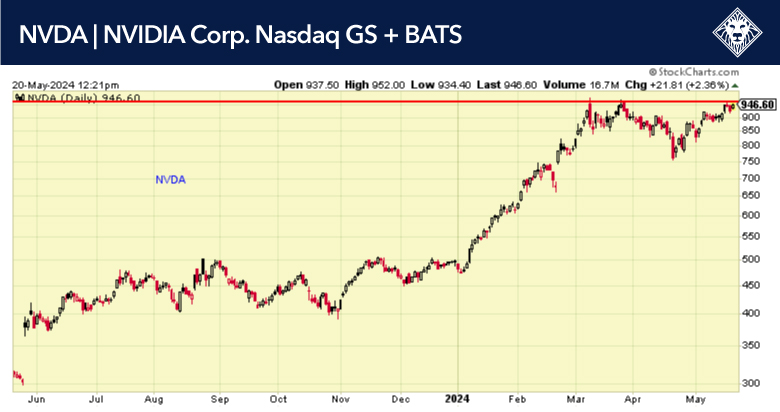
5-20-24-NVDA

Chart: NVDA 1-year daily

Nvidia (NVDA) is on everyone’s mind this week, as they are scheduled to report earnings on Wednesday. The stock has sold off just a bit, which could be a good thing if they blow past expectations. (NVDA) is hitting resistance, but a breakout could be very strong. Nvidia has had an amazing run, but there is no reason it can’t double again.

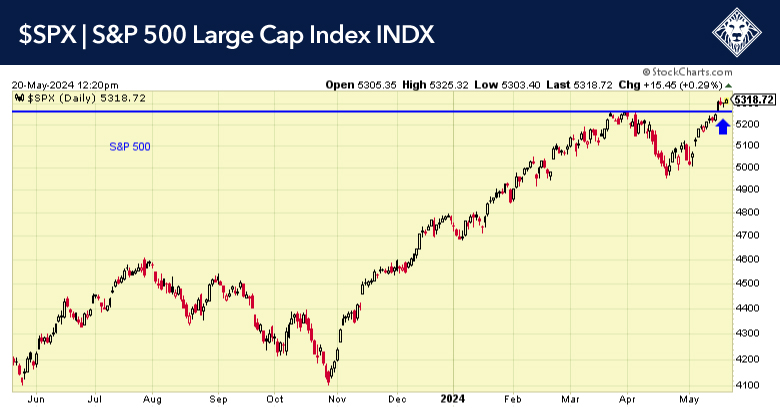
5-20-24-SPX

Chart: SPX 1-year daily

The S&P 500 has broken out above its 5/1 high and should pull back just a bit, but again, all pullbacks should be considered buyable at this point. We see the market moving higher throughout the year and we think it could surprise everyone with just how much strength it has – possibly even pushing up to the 5600-5700 level. The old trader’s saying is “sell in May and go away”, but that does not look like the case this year. Maybe we will have to update the saying to “buy in May and stay”.

5-20-24-TLT

Chart: TLT 1-month daily

The bond market has moved up as TLT, the 20-year treasury ETF, is moving higher and interest rates are moving lower organically.

The Conference Board’s Leading Economic Index (LEI) fell 0.6% in April, the most in six months, and double the consensus estimate of -0.3%. Half of the LEI’s ten components made negative contributions, led by worsening consumer expectations of business conditions, falling manufacturing new orders, and declining building permits.

The six-month annualized rate of change of the LEI, however, improved last month to -3.9%, the slowest pace of decline since May 2022. Although still negative, this rate of change has moved closer to the zone that historically has meant sustained economic growth.


Inflation Pressure Eases – Time For The Fed To Cut Rates?

5-15-24-SPX

Chart: SPX 1-year daily

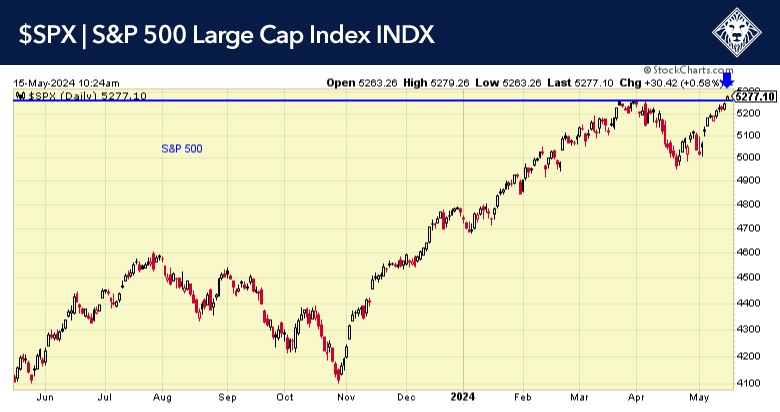
The market is about to break out, in our opinion. We expect it to hit resistance at the high set around March 28th, and a small, buyable pullback should take place. Once we break above the March 28th high, look for a nice rally on the breakout.

5-15-24-HCM-PP

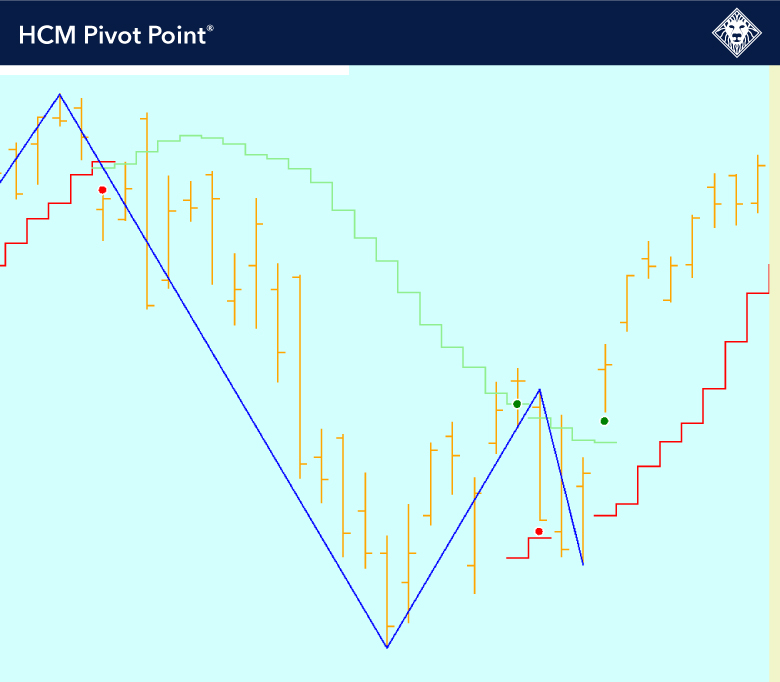
The HCM Pivot Point® signaled a sell on the very modest pullback we had in April. We reduced exposure to equities by about $1.1 billion, which was then put back on when the HCM Pivot Point® turned back up. All the money we took off was reinvested at a lower price. I’m coming to the conclusion that the HCM Pivot Point® trading system might be the best system we have built. Even with the very shallow pullback it did its job very well in my opinion.

There was a nice print on the CPI this morning as clearly interest rate hikes are working. What does this tell us? Well, we think the most important tell is that the Fed is done raising rates and will hold steady until there is additional evidence that a rate cut is needed. This is very good and constructive news for stocks in our opinion.

April Core CPI came in at +0.29% MoM, below Street consensus of +0.30%. This was a clean “good” CPI reading, with the right components showing a slowdown. The 2 things we watched closely showed improvement: Shelter slowed modestly to +0.38% MoM vs +0.42% last month and auto insurance slowed to +1.76% vs +2.58% last month.

Bottom line: This was a good CPI print and justifies stocks rising into the end of the month. The next key data point is April PCE at the end of the month, which should keep the Fed leaning dovish.


Market Gymnastics – Bouncing Markets And How To Navigate Them

4-22-24-SOXX

Chart: SOXX 1-year daily

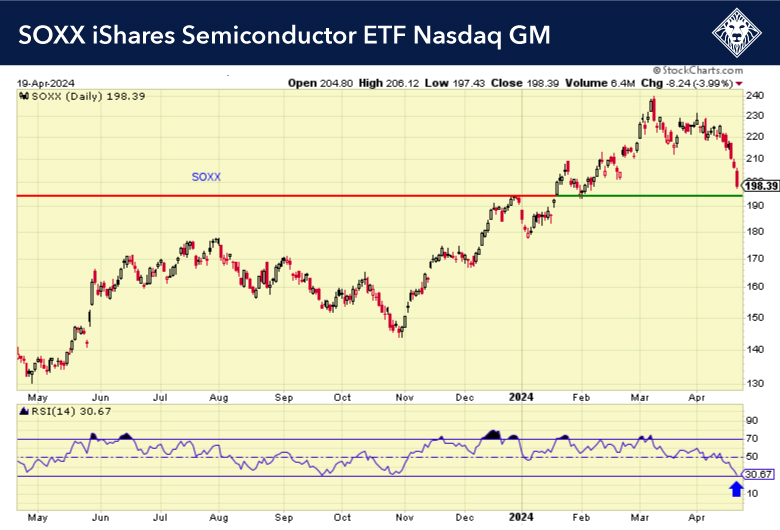
The markets sold off just as we had predicted, which should not surprise anyone after a very long stretch of positive weeks. We moved about $1.1 billion to cash and one-month T-bills at the beginning of the selloff due to several HCM Pivot Points being hit. This gives us a lot of buying power when the market turns back up. The intermediate-term trend, as identified by the HCM-BuyLine® is still positive, but has weakened, and we are monitoring closely. We believe the selloff has created many opportunities, and we will be watching for the HCM Pivot Points to turn back up so we can start buying some of them. One area of extreme interest is semiconductors (SOXX).

4-22-24-SPY

Chart: SPY 1-year daily

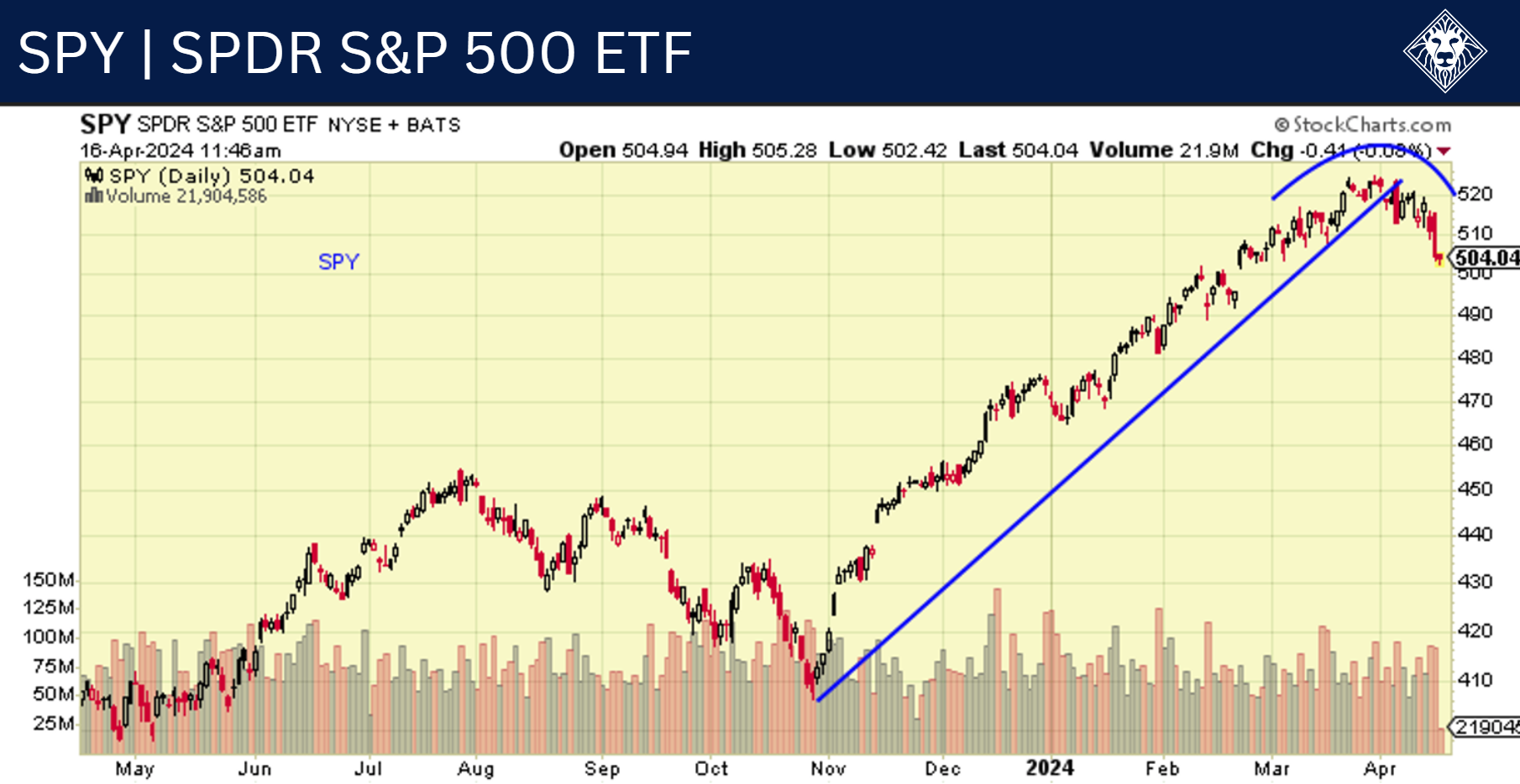
Seasoned traders also look for what is called a 50% retracement, and I have added a chart of the S&P 500 where you can see that it is getting closer to that level. We think there will probably be a few up-days followed by additional selling pressure before the market finds a place of support. The markets are deeply oversold on a short-term basis, so a modest bounce should most likely be coming. The market will take a little time to work through the technical damage of the current selloff, so don’t expect a straight shot back up, but rather a slow grinding process, which is healthy.


Short-Term Turmoil – Can the market keep pushing?

SPY

The S&P 500 has pulled back and closed below its 50-day moving average, indicating a structural breakdown. We remain bullish, but a short-term correction is likely underway. Investors are de-risking and moving money to cash and/or short-term bonds. Does this change our view of the S&P 500 closing above 5500 this year? No, we still anticipate stocks moving higher.

Geopolitical risks are clearly at play, but looking at the upward move of the S&P 500 a pullback was warranted, and a period of consolidation was needed. With the market breaking below the 50-day moving average, some short-term damage has been done and will need to be repaired for the market to continue its climb.

So far earnings are looking good. 42 companies are reporting this week, and of the 34 companies that have reported so far (7% of the S&P 500): Overall, 85% are beating estimates, and those that “beat” are beating by a median of 9%. Of the 15% missing, those are missing by a median of -4%. On the top line, overall results are beating estimates by a median of 3% and missing by a median of -2%, and 56% of those reporting are beating estimates.

Retail sales increased 0.7% in March, more than double the consensus estimate of 0.3%. Additionally, the previous month was revised up to 0.9% from 0.6%, fully erasing the weather-related drop at the start of the year. It confirms the economy has ended Q1 with strong consumer demand, which partly explains elevated inflation. Strong growth and relatively high inflation have pushed off market expectations for Fed rate cuts until later this year.


Market Momentum – Zooming Ahead or Bracing for Trouble?

4-9-24-SPY

The market continues to trade in a strong upward channel, but we think it is currently overbought and a pullback will most likely occur. This should be considered a buying opportunity, as we see the market moving higher throughout the year. Energy has been moving higher with the instability in the Middle East and has the potential to keep inflation from dropping, as all hope it will.

In Q4, U.S. economic growth exceeded previous estimates, with real GDP rising to a 3.4% annualized rate. Upward revisions to consumer spending, business investment, and government spending were partly offset by decreases in inventories and net exports. Real final sales to domestic purchasers, excluding inventories and net exports, increased to a 3.5% annualized rate, indicating robust domestic demand. This trend suggests continued growth in the near term, supported by a drop in our recession probability model. Fiscal stimulus exceeding $5 trillion during the pandemic, alongside ongoing government support, has kept the economy expanding, driving inflation. Despite the Fed raising rates in March 2022 to counter inflation, the economy grew beyond potential in the second half of 2023. With inflation persisting above 2%, there’s concern that any Fed easing could risk overheating the economy, especially as fiscal policies like the Infrastructure Investment and Jobs Act continue to support growth. While supportive for equity markets historically, such policies may exacerbate inflation if they push growth beyond capacity.

The Consumer Price Index for All Urban Consumers (CPI-U) increased 0.4 percent in February on a seasonally adjusted basis, after rising 0.3 percent in January, the U.S. Bureau of Labor Statistics reported today. Over the last 12 months, the all items index increased 3.2 percent before seasonal adjustment.

The index for shelter rose in February, as did the index for gasoline. Combined, these two indexes contributed over sixty percent of the monthly increase in the index for all items. The energy index rose 2.3 percent over the month, as all of its component indexes increased. The food index was unchanged in February, as was the food at home index. The food away from home index rose 0.1 percent over the month.

The index for all items less food and energy rose 0.4 percent in February, as it did in January. Indexes which increased in February include shelter, airline fares, motor vehicle insurance, apparel, and recreation. The index for personal care and the index for household furnishings and operations were among those that decreased over the month.

The all items index rose 3.2 percent for the 12 months ending February, a larger increase than the 3.1-percent increase for the 12 months ending January. The all items less food and energy index rose 3.8 percent over the last 12 months. The energy index decreased 1.9 percent for the 12 months ending February, while the food index increased 2.2 percent over the last year.